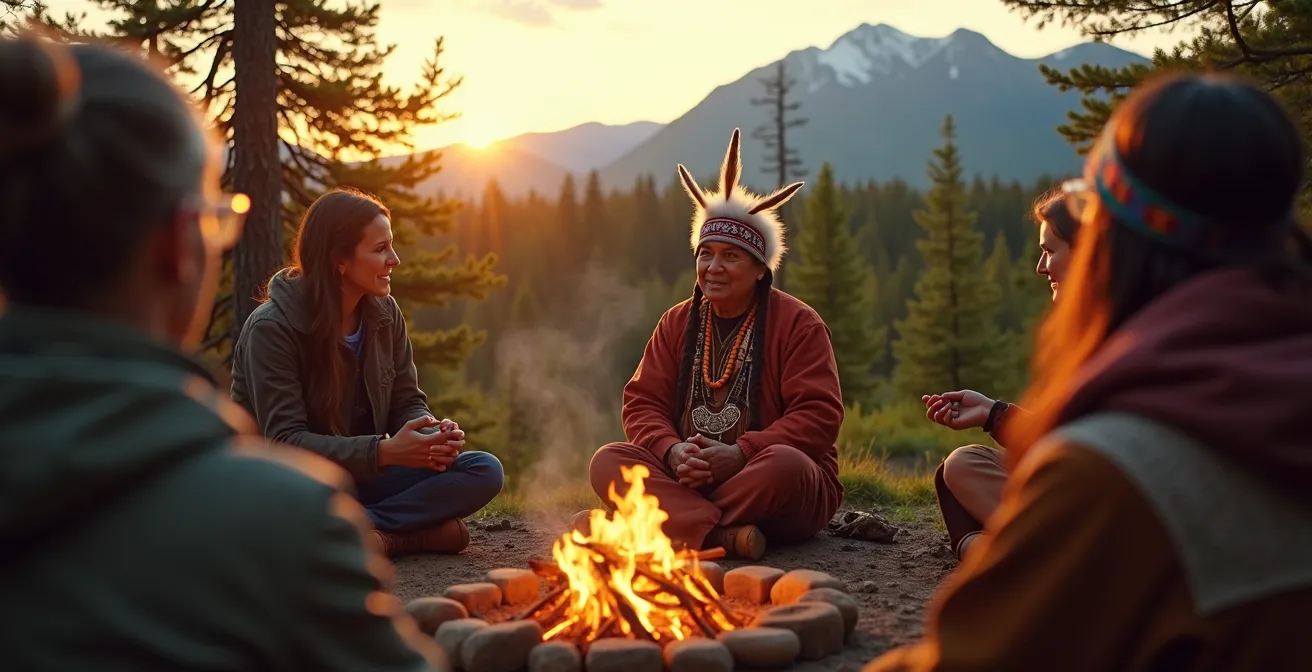
Building a successful Indigenous tourism venture is not about selling a product; it’s about enacting economic sovereignty through a process rooted in legitimate cultural protocol.
- Success hinges on securing genuine community consent and navigating governance, not just having a good idea.
- Strategic funding through programs like ITAC’s requires demonstrating market-readiness and deep community integration.
- Authenticity is protected through every choice, from ethical souvenir sourcing to training guides as cultural ambassadors.
Recommendation: Prioritize establishing right relations and formal agreements with your community’s leadership—both elected and hereditary—before seeking any external funding or partners. This is your foundation.
As an Indigenous entrepreneur or community leader in Canada, you hold something invaluable: a connection to culture, land, and stories that have endured for millennia. The desire to share this richness is powerful, and tourism presents a path toward economic self-determination. Yet, the common advice to simply “be authentic” and “work with your community” often fails to address the complex reality of our world. It overlooks the intricate governance systems, the sacred responsibility of knowledge-keeping, and the very real risk of cultural commodification.
Many ventures start with a focus on the visitor experience, developing tours or products they believe tourists want. They chase funding and partnerships, sometimes putting the business plan before the protocols that give it legitimacy. But what if the true foundation of a thriving, resilient Indigenous tourism business isn’t the market, but the relationship with the source of the culture itself? What if the most critical first step has nothing to do with a business plan, but with sitting down with your Elders?
This guide moves beyond the surface-level advice. It is built on the principle that economic sovereignty is achieved through protocol. We will explore how to build a venture from the ground up, starting with the non-negotiable step of Elder approval and the right way to navigate community governance. We will then break down the strategic approach to securing funding, choosing the right business model, and ensuring every aspect of your operation—from the gift shop to the guided tour—reinforces cultural integrity and generates reciprocal benefits for your people. This is not just about creating an experience for others; it’s about building a sustainable economic engine that strengthens your Nation.
This article provides a roadmap for building your tourism venture on a foundation of respect and protocol. Follow along as we explore the essential steps to ensure your enterprise is both economically successful and culturally sound.
Summary: A Protocol-First Approach to Indigenous Tourism Development
- Why You Must Seek Elder Approval Before Commercializing Traditional Knowledge?
- How to Apply for the Indigenous Tourism Association of Canada (ITAC) Grants?
- Community-Owned vs. Entrepreneur-Led: Which Model Suits Your Goal?
- The Souvenir Sourcing Mistake That Dilutes Authenticity
- How to Train Guides to Bridge the Cultural Gap for International Tourists?
- The Protocol Error That Can Stall Your Resource Project for Months
- How to Structure a Joint Venture with Western Indigenous Development Corporations?
- Investing in Natural Resources: How to Build Partnerships with Indigenous Communities?
Why You Must Seek Elder Approval Before Commercializing Traditional Knowledge?
Before a single dollar is sought or a brochure is printed, the journey of an Indigenous tourism venture must begin in the heart of the community: with the Elders. This is not a symbolic gesture or a box to be checked; it is the fundamental “legitimacy test” for your entire enterprise. Commercializing traditional knowledge, stories, or access to ancestral lands without explicit, documented consent from its keepers is an extractive act, regardless of intention. Seeking approval is the first and most critical step in practicing economic sovereignty, ensuring that the benefits flow back to the source and that the culture itself is protected, not sold.
The process honours the fact that knowledge is not individually owned. It belongs to the collective and is stewarded by Elders who hold the context, the history, and the responsibilities associated with it. Approaching them demonstrates respect for inherent laws and governance structures that have existed long before colonial systems. This protocol-first approach is also a powerful business strategy. It builds a rock-solid foundation of community support, which is often a key criterion for funding bodies and ethical partners. With the Indigenous tourism sector’s economic impact growing significantly, establishing this legitimacy is paramount. According to the Conference Board of Canada, the sector generated an estimated $3.7 billion in revenue and supported 54,700 jobs in 2023 alone, and funders are increasingly looking for projects with deep, authentic community backing.
Engaging properly requires understanding that many Nations in Canada operate under a dual-governance system, with both an elected Chief and Council (under the Indian Act) and Hereditary Chiefs who hold authority through traditional laws. A Band Council Resolution (BCR) may be a necessary legal instrument, but it is often insufficient on its own. True consent, in line with the principles of Free, Prior, and Informed Consent (FPIC) as outlined in the United Nations Declaration on the Rights of Indigenous Peoples (UNDRIP), requires meaningful engagement with all relevant leadership structures. This deep consultation ensures your venture is not just tolerated, but truly embraced by the community it represents.
Ultimately, securing this consent is what transforms a personal business idea into a legitimate community asset. It is the difference between a venture that is merely Indigenous-themed and one that is genuinely Indigenous-led, resilient, and respectful.
How to Apply for the Indigenous Tourism Association of Canada (ITAC) Grants?
Securing funding is often the catalyst that turns a vision into a reality. In Canada, the Indigenous Tourism Association of Canada (ITAC) and the federal government have established several key funding streams specifically designed to support the growth of our sector. However, applying for these grants requires more than a good idea; it demands a strategic understanding of what each program is designed to achieve. Simply filling out a form is not enough. Your application must tell a compelling story of community support, market readiness, and cultural integrity.
The available funding is intentionally structured to support businesses at different stages of development. It is crucial to identify which stream aligns with your project’s scale and readiness. A new entrepreneur with a powerful idea might target the Micro & Small Business Stream for initial capacity building, while a Nation looking to build a major cultural centre would look to the Signature Indigenous Tourism Experiences Stream (SITES). This strategic alignment is key to a successful application. As detailed in a recent Government of Canada overview, these programs are part of a coordinated effort to foster sustainable growth.
| Program | Funding Amount | Target Recipients | Key Focus |
|---|---|---|---|
| ITAC Micro & Small Business Stream | $10 million total | Small Indigenous tourism operators | Business readiness, infrastructure upgrades |
| Signature Indigenous Tourism Experiences (SITES) | $10 million ($500K-$1M per project) | Large-scale anchor experiences | Major tourism destinations, infrastructure |
| Indigenous Tourism Fund (ITF) | $20 million total | All Indigenous tourism businesses | Recovery and sustainable growth post-pandemic |
| Regional Development Agencies | Varies by region | Regional businesses | PacifiCan, FedNor, ACOA – regional priorities |
A powerful application demonstrates that you have already done your homework. This includes securing community consent, developing a clear business plan, and identifying your target market. The SITES program, for example, is highly competitive and looks for “anchor experiences” that can draw international visitors and have significant economic spinoffs. A successful proposal for this stream must show a high degree of planning and professionalism.
SITES Program Success: Kwanlin Dün First Nation’s Sky High Wilderness Ranch
A prime example of a successful application is the Kwanlin Dün First Nation, which received $755,000 through the Signature Indigenous Tourism Experiences Stream (SITES) to expand its off-grid accommodations at Sky High Wilderness Ranch near Fish Lake, Yukon. The funding enabled the addition of new log cabin units to host larger groups. This project was successful because it clearly demonstrated market readiness by diversifying its year-round offerings (dog-sled tours, aurora viewing) and was built on a strong foundation of community support and cultural authenticity, making it a perfect fit for the SITES program’s goals.
By carefully selecting the right grant and building a case that proves your project’s viability and community integration, you can unlock the critical capital needed to share your culture with the world on your own terms.
Community-Owned vs. Entrepreneur-Led: Which Model Suits Your Goal?
One of the most strategic decisions you will make is choosing the right governance structure for your tourism venture. There is no single “best” model; the choice between a community-owned enterprise (often run by a Band Council or Development Corporation) and an entrepreneur-led business depends entirely on your goals, your community’s context, and your capacity. Understanding the strengths and challenges of each path is crucial for long-term sustainability and ensuring benefits are shared appropriately.
A community-owned model is powerful for large-scale projects that require significant capital and land use, such as a cultural centre or resort. Profits can be directed toward community programs, housing, and social services, creating broad benefits. However, this model can sometimes move slowly due to political cycles and the need for extensive consensus-building. An entrepreneur-led model, on the other hand, offers agility and the ability to pivot quickly in response to market changes. This structure is often ideal for smaller, niche experiences like guided tours, workshops, or culinary businesses. It also provides a direct path to wealth creation for individuals and families, and it’s a significant driver of economic empowerment, as 36% of Indigenous tourism businesses in Canada are owned by women.

As the image above symbolizes, these two paths are not mutually exclusive. A growing number of successful ventures are pioneering hybrid models. In this structure, an Indigenous entrepreneur operates the business but does so under a formal Community Contribution Agreement. This legal framework ensures the venture remains accountable to the collective, outlining commitments such as local hiring targets, youth mentorship programs, and a percentage of profits dedicated to a cultural revitalization fund. This approach combines the dynamism of private enterprise with the accountability and deep community connection of a social enterprise.
The key is to match the model to the mission. If the primary goal is widespread employment and funding for social programs, a community-owned structure may be best. If the goal is to create a highly specialized, world-class experience driven by a specific family’s knowledge, an entrepreneurial model with a strong contribution agreement could be the ideal path. The choice defines who holds the risk, who makes decisions, and how the rewards of your hard work flow back to the people and culture at its source.
Ultimately, the right structure is the one that best enables you to achieve your vision of economic sovereignty while upholding your responsibilities to your culture and community.
The Souvenir Sourcing Mistake That Dilutes Authenticity
The gift shop or retail component of a tourism venture is far more than a simple revenue stream; it is a physical extension of your story and a final, tangible touchpoint for your guests. A common and deeply damaging mistake is to stock it with mass-produced, inauthentic “Indigenous-style” trinkets sourced from overseas. This decision, often made to increase profit margins, instantly dilutes the authenticity of the entire experience you have worked so hard to create. It sends a message that your culture is a design that can be copied, not a living heritage that must be respected.
Protecting the integrity of your retail space means treating it as a gallery, not just a store. It means committing to an ethical supply chain that sources directly from Indigenous artists and creators within your own Nation and from others. Every item on the shelf should have a story, a connection to a person, and a place. This commitment to authenticity is a core principle of organizations like Destination Indigenous, who champion the idea that these are not mere products.
Every piece, from the smallest bracelets to the largest sculpture, tells a story that transcends generations and the ages. Every purchase you make helps to keep those stories alive.
– Destination Indigenous, Canadian Indigenous Tourism Platform
Building an ethical supply chain requires a proactive and transparent process. It’s not just about what you sell, but how you sell it. Educating your staff and your customers on the difference between a handmade piece of art and a mass-produced souvenir is essential. This creates an appreciation for the skill, time, and cultural capital embedded in each authentic item. The following checklist outlines a practical framework for establishing a retail operation that truly honours Indigenous artists and amplifies your message of authenticity.
Your Action Plan: Building an Ethical Indigenous Souvenir Supply Chain
- Partnerships & Certification: Partner directly with local Indigenous artists and community art collectives. Seek certification through programs like ITAC’s ‘The Original Original’ to provide a clear mark of authenticity for visitors.
- Storytelling & Traceability: Implement a system, such as QR codes on tags, that links each product to the artist’s biography, their story, and the cultural significance of the piece. Make the artist visible.
- Staff Training & Value Proposition: Train your retail staff with specific talking points to explain the value difference between authentic handmade items and imitations. They must be able to articulate why a piece is priced the way it is.
- Transparent Pricing: Where appropriate and with artist consent, create displays that show the percentage of the sale price that goes directly to the artist. This transparency builds trust with both artists and customers.
- Fair Payment Terms: Establish fair consignment or wholesale agreements that ensure artists are paid promptly and respectfully for their work, moving away from exploitative models.
By transforming your gift shop into a space of storytelling and genuine support for Indigenous creators, you not only create a powerful and memorable final impression for your guests but also build another pillar of your community’s sovereign economy.
How to Train Guides to Bridge the Cultural Gap for International Tourists?
Your guides are not simply tour leaders; they are cultural ambassadors, interpreters, and, most importantly, the primary stewards of the visitor experience. The most beautifully crafted tourism venture can be undermined by guides who are unprepared to navigate the complex cultural gap between themselves and an international audience. Effective training goes far beyond memorizing a script. It’s about equipping guides with the skills to share deep truths, manage sensitive topics, and set respectful boundaries, all while creating an engaging and transformative experience for guests.
International tourists often arrive with a mixture of curiosity, stereotypes, and a profound lack of context about the history and diversity of Indigenous Peoples in Canada. A well-trained guide knows how to meet them where they are. This involves learning techniques to explain complex concepts—like the meaning of “unceded territory” or the distinction between First Nations, Métis, and Inuit—in simple, accessible terms without sacrificing accuracy. It also means preparing them for difficult questions about topics like residential schools. The goal is not to have all the answers, but to have a protocol for responding in a way that is trauma-informed, educational, and directs visitors to authoritative resources for deeper learning.
This process of interpretation is a delicate art, balancing the responsibility to share truth with the need to protect sacred or private community knowledge. Guides must be trained to be “cultural gatekeepers,” empowered to decide what is appropriate to share in a public setting and what is not. This training builds confidence and reinforces the guide’s essential role in protecting the community’s cultural capital.
Wikwemikong Tourism’s Cultural Guide Training Program
An outstanding model for this is the ‘Unceded Journey’ program developed by Wikwemikong Tourism on Manitoulin Island, located in Canada’s only federally recognized unceded territory. Local guides undergo extensive training that covers the true history of the land and their people. A key component is a trauma-informed approach to discussing sensitive histories like residential schools. The program empowers guides to navigate these conversations with authenticity and care, teaching them to set boundaries and protect sacred knowledge while providing a profound educational experience for visitors, demonstrating the critical role of the guide as a cultural gatekeeper.
By investing heavily in your guides, you are investing in the heart of your visitor experience. You empower them to transform a simple tour into a moment of genuine connection and understanding, which is the ultimate measure of authentic Indigenous tourism.
The Protocol Error That Can Stall Your Resource Project for Months
While this guide focuses on tourism, the principles of protocol and partnership are universal across all forms of Indigenous economic development, including natural resource projects. In fact, lessons from the resource sector offer a powerful cautionary tale for tourism entrepreneurs. A single protocol error—like misidentifying the correct rights-holders or ignoring a jurisdictional requirement—can stall a multi-million dollar project for months or even years. For a tourism venture, which often involves building infrastructure on traditional territory, these same risks apply.
The most common and costly mistake is assuming that a Band Council Resolution (BCR) from the elected Chief and Council is the final and only approval needed. As discussed earlier, many Nations have dual-governance systems. Proceeding without the consent of Hereditary Chiefs, whose authority flows from traditional law, can lead to direct action, legal challenges, and a complete loss of social license. This oversight demonstrates a fundamental failure to complete due diligence and respect the Nation’s inherent governance.
Furthermore, development on traditional lands often triggers a complex web of overlapping jurisdictions. A project may require approvals from the Band, hereditary leadership, the province, and multiple federal departments like Fisheries and Oceans Canada (DFO) or Environment and Climate Change Canada (ECCC). Failing to map out this entire approval pathway from the very beginning is a recipe for delay and budget overruns. Understanding this complex landscape is not just for mining or forestry; it’s essential for any significant tourism infrastructure project.
The following table illustrates the typical layers of approval and the common oversights that can derail a project. It serves as a critical reminder that “moving fast” is often the slowest path forward if it means skipping a step in protocol.
| Authority Level | Required Approvals | Typical Timeline | Common Oversights |
|---|---|---|---|
| Band Council | Band Council Resolution (BCR) | 2-4 months | Assuming BCR is final approval |
| Hereditary Chiefs | Traditional governance consent | 3-6 months | Not recognizing dual governance systems |
| Provincial | Land use permits, environmental assessments | 6-12 months | Overlooking provincial jurisdiction on traditional territory |
| Federal (DFO, ECCC) | Fisheries permits, species at risk assessments | 4-8 months | Not identifying federal trigger early |
| Environmental | Impact assessments, water permits | 6-18 months | Underestimating cumulative effects review |
By applying the same rigour to tourism development as is required in the resource sector, you build a project that is not only culturally legitimate but also legally and financially resilient.
How to Structure a Joint Venture with Western Indigenous Development Corporations?
For ambitious tourism projects that require significant capital, forming a joint venture (JV) with an Indigenous Development Corporation can be a powerful strategy. These corporations, particularly the established ones across Western Canada, have sophisticated governance, access to capital, and extensive experience in managing large-scale economic projects. Partnering with them can provide the financial muscle and business acumen needed to bring a major vision to life. However, a successful JV is built on much more than a strong business case; it requires a foundation of shared values and reciprocal due diligence.
Tokenism is the greatest risk in any partnership. A true joint venture is not a non-Indigenous company “hiring” an Indigenous partner for appearances. It must be a relationship of equals, with shared risk, shared decision-making, and an equitable share of the benefits. This often means aiming for structures with 50/50 board representation and clearly defined IP protections for cultural stories and place names used in the venture. For an Indigenous entrepreneur approaching a Development Corporation, you must demonstrate a solid business plan. For a non-Indigenous entity, you must demonstrate a genuine, long-term commitment to reconciliation and Indigenous prosperity, not just short-term profit.
The National Aboriginal Capital Corporations Association (NACCA) network serves as a powerful example of the capacity within Indigenous-led financial institutions to manage and facilitate these large-scale partnerships, ensuring they are structured for community benefit.
NACCA’s Network Success in Indigenous Economic Development
Representing over 50 Indigenous Financial Institutions, NACCA has facilitated an incredible $3.3 billion in loans to Indigenous businesses over 35 years. Their successful management of programs like the Signature Indigenous Tourism Experiences Stream, which recently directed $10 million to major tourism projects, proves the immense capacity of Indigenous Development Corporations. They are not just partners; they are expert institutions capable of leading complex, multi-million dollar ventures that drive economic sovereignty across Western Canada and beyond.
Before entering into any JV agreement, both parties must conduct thorough and reciprocal due diligence. This process goes beyond financial statements and legal reviews; it is a deep assessment of cultural alignment and long-term commitment. The following checklist provides a framework for this critical evaluation process.
- For Non-Indigenous Partners evaluating Indigenous Development Corporations: Verify their mandate from the community, review governance structure, assess the level of community support through BCRs, and check their financial track record with NACCA members.
- For Indigenous Development Corporations evaluating partners: Review the partner’s commitment to UNDRIP principles, assess their track record with previous Indigenous partnerships, evaluate the fairness of benefit-sharing proposals, and verify they have no history of tokenism.
- Joint requirements: Clearly define intellectual property protections for cultural stories and place names, establish 50/50 board representation, and agree on dispute resolution mechanisms that can incorporate Indigenous legal principles.
- Cultural alignment verification: Document shared values on stewardship and community, confirm a long-term commitment beyond immediate profit, and establish mandatory cultural protocol training for all non-Indigenous leadership.
A well-structured JV can be a powerful engine for reconciliation in action, combining the best of both worlds to create enterprises that are both highly profitable and deeply purposeful.
Key Takeaways
- Indigenous tourism success is built on a “protocol-first” approach, where Elder and community consent is the non-negotiable foundation for any business activity.
- Strategic funding requires aligning your project’s scale and readiness with specific grant streams (e.g., ITAC’s SITES for major projects vs. micro-grants for startups).
- Authenticity must be actively managed across all touchpoints, especially in retail, by creating ethical supply chains that directly support Indigenous artists and tell their stories.
Investing in Natural Resources: How to Build Partnerships with Indigenous Communities?
The health of the land is the health of the culture. For Indigenous tourism, this is not a metaphor—it is a literal truth. The pristine lakes, ancient forests, and abundant wildlife that draw visitors are the very foundation of the cultural and spiritual practices you share. Therefore, building strategic partnerships related to natural resources and conservation is not a separate activity from tourism; it is an essential part of a holistic strategy for economic sovereignty and long-term resilience.
This means moving beyond a simple “tourism vs. resource extraction” mindset and toward a vision of integrated stewardship. Partnerships can take many forms. They might involve collaborating with conservation bodies to establish Indigenous Protected and Conserved Areas (IPCAs), where tourism activities are designed to support ecological monitoring and restoration. It could mean working with sustainable forestry or fishery operations to ensure their practices uphold Indigenous values and do not harm the visitor experience. It could also mean leveraging your community’s Section 35 rights to ensure a share of the benefits from any resource project on your territory is invested back into community-owned tourism infrastructure.
These partnerships are critical for achieving the ambitious growth targets set for our sector. With a goal to reach $6 billion in GDP contribution and 60,000 direct jobs by 2030, the Indigenous tourism industry cannot exist in a vacuum. It must be a key player at the table where decisions about the land are made. By asserting your role as stewards and building alliances, you protect the core asset of your business—a healthy and vibrant territory—while creating diversified revenue streams that strengthen your Nation’s economic base.
Building these alliances requires the same principles as any other partnership: respect, transparency, and a commitment to reciprocal benefit. It is about ensuring that any activity on the land, whether it’s a guided hike or a resource project, contributes to the well-being of the community and the environment. This integrated approach ensures that the growth of Indigenous tourism is not just sustainable, but also actively contributes to the process of economic reconciliation and the revitalization of our relationship with the land.
Begin today by identifying the key stakeholders managing the lands and waters in your territory. The next step is to initiate a dialogue, grounded in your rights and your vision, to forge partnerships that will protect your culture’s foundation for generations to come.
Frequently Asked Questions about Indigenous Tourism in Canada
Can you tell us about residential schools?
Residential schools were government-funded institutions that forcibly separated Indigenous children from their families to assimilate them. While this is a painful part of our history, we share these stories to promote understanding and healing. We can direct you to the National Centre for Truth and Reconciliation for detailed information.
What’s the difference between First Nations, Métis, and Inuit?
These are three distinct Indigenous groups in Canada. First Nations are diverse Indigenous peoples south of the Arctic, Inuit are Indigenous peoples of the Arctic, and Métis are people of mixed Indigenous and European ancestry with their own distinct culture. Each has unique languages, traditions, and governance systems.
Can I participate in sacred ceremonies?
Some ceremonies are open to respectful visitors while others are private to our community. We’ll clearly indicate which cultural experiences are appropriate for sharing. When invited to participate, we ask that you follow our protocols and guidance. This includes asking before taking any photographs or recordings, as many ceremonies prohibit this to maintain their sacredness.