The greatest risk to Canadian resource projects isn’t geology or markets; it’s a flawed, transactional approach to Indigenous relations.
- Superficial “check-the-box” consultation is the direct path to project delays, court injunctions, and lost investor confidence.
- Moving from a stakeholder-management mindset to one of co-creation with sovereign economic partners is the key to unlocking project certainty.
Recommendation: Shift your strategy from simply writing cheques for Impact Benefit Agreements (IBAs) to co-designing equity-based partnerships that create lasting, shared economic value and operational stability.
For any mining or forestry executive in Canada, securing a social license to operate is paramount. Yet, the landscape of Indigenous relations is littered with stalled projects, costly legal battles, and fractured trust. The conventional approach—viewing consultation as a procedural hurdle and Impact Benefit Agreements (IBAs) as a simple cost of business—is fundamentally broken. It treats First Nations, Métis, and Inuit communities as stakeholders to be managed, rather than as the sovereign partners they are.
This outdated model not only fails to meet the legal standard of the Duty to Consult but also ignores the powerful business case for genuine partnership. The narrative is shifting from risk mitigation to value co-creation. In an era of economic reconciliation, companies that continue to “check the box” will be left behind, mired in conflict and uncertainty. The true opportunity lies in building authentic, nation-to-nation relationships grounded in respect, mutual benefit, and a shared vision for the future.
But what does this look like in practice? It means moving beyond royalties to explore equity participation. It means understanding that protocol is not a formality but a foundational element of governance. This guide is designed for executives who are ready to move beyond the checklist. It provides a strategic framework for transforming your approach to Indigenous engagement, ensuring your projects not only get approved but thrive with the full partnership of the communities whose traditional territories you operate on.
text
For those who prefer a visual summary, the following video showcases several success stories in Aboriginal business, illustrating the potential of effective partnerships.
This article will deconstruct the common pitfalls and provide a clear roadmap for building resilient, value-driven alliances. We will explore the nuances of consultation, IBA negotiation, partnership models, and cultural protocol, providing actionable insights at every stage.
Summary: A Strategic Guide to Indigenous Partnership in the Resource Sector
- Why “Checking a Box” on Consultation Leads to Court Injunctions?
- How to Negotiate an Impact Benefit Agreement (IBA) That Creates Shared Value?
- Equity Participation vs. Royalties: Which Model do First Nations Prefer?
- The Protocol Error That Can Stall Your Resource Project for Months
- How to Build a Skills Training Program That Actually Hires Local Talent?
- How to Structure a Joint Venture with Western Indigenous Development Corporations?
- Why You Must Seek Elder Approval Before Commercializing Traditional Knowledge?
- Promoting Cultural Exploration: How to Develop Authentic Indigenous Tourism Experiences?
Why “Checking a Box” on Consultation Leads to Court Injunctions?
The term “Duty to Consult” is often misinterpreted by resource companies as a procedural checklist: hold meetings, take notes, file reports. This view is not only culturally inappropriate but legally perilous. Canadian courts have repeatedly affirmed that consultation must be meaningful, not mechanical. A superficial process that fails to genuinely incorporate and respond to community concerns is seen as a failure to uphold the honour of the Crown, often leading directly to project-halting injunctions.
The international standard is even clearer. The United Nations Declaration on the Rights of Indigenous Peoples (UNDRIP), now part of Canadian law, sets a high bar. A legal analysis of its implementation in Canada confirms that Article 32(2) of UNDRIP requires obtaining free, prior, and informed consent (FPIC) before approving any project affecting Indigenous lands or resources. “Informed consent” cannot be achieved through a PowerPoint presentation and a comment box. It requires a deep, two-way dialogue where the community has genuine agency over the decisions being made.
Failures often stem from fundamental misunderstandings of Indigenous governance. For instance, engaging only with the elected Band Council while ignoring Hereditary Chiefs or Elders’ councils is a classic mistake. One represents the Indian Act system, the other traditional law; both are often essential for community consensus. Arriving at initial meetings without senior company leadership (VP or C-suite) signals a lack of genuine commitment and can poison the relationship from the start. True consultation respects community timelines, recognizes complex governance structures, and treats the process as the beginning of a long-term relationship, not a box to be ticked for a permit.
How to Negotiate an Impact Benefit Agreement (IBA) That Creates Shared Value?
For decades, Impact Benefit Agreements (IBAs) were primarily transactional, often consisting of a lump-sum payment or royalty stream in exchange for community consent. This model fosters dependency, not partnership. The modern, strategic approach to IBAs is to frame them as tools for co-creating long-term, sustainable economic value for the First Nation partner, which in turn de-risks the project for the company.
A prime example of this shift is the partnership at Vale’s Sudbury mine. Rather than a simple payment, the agreement involved a strategic investment. Natural Resources Canada provided $2.7 million in capacity funding to Giyak Mishkawzid Shkagmikwe Inc., a company owned by Atikameksheng Anishnawbek and Wahnapitae First Nation. This enabled them to purchase mining drills and secure a three-year drilling contract. The First Nations are now active participants in the supply chain, generating significant revenue and operational expertise. This is shared value in action: the community builds a real business, and the mine secures a reliable, local contractor.
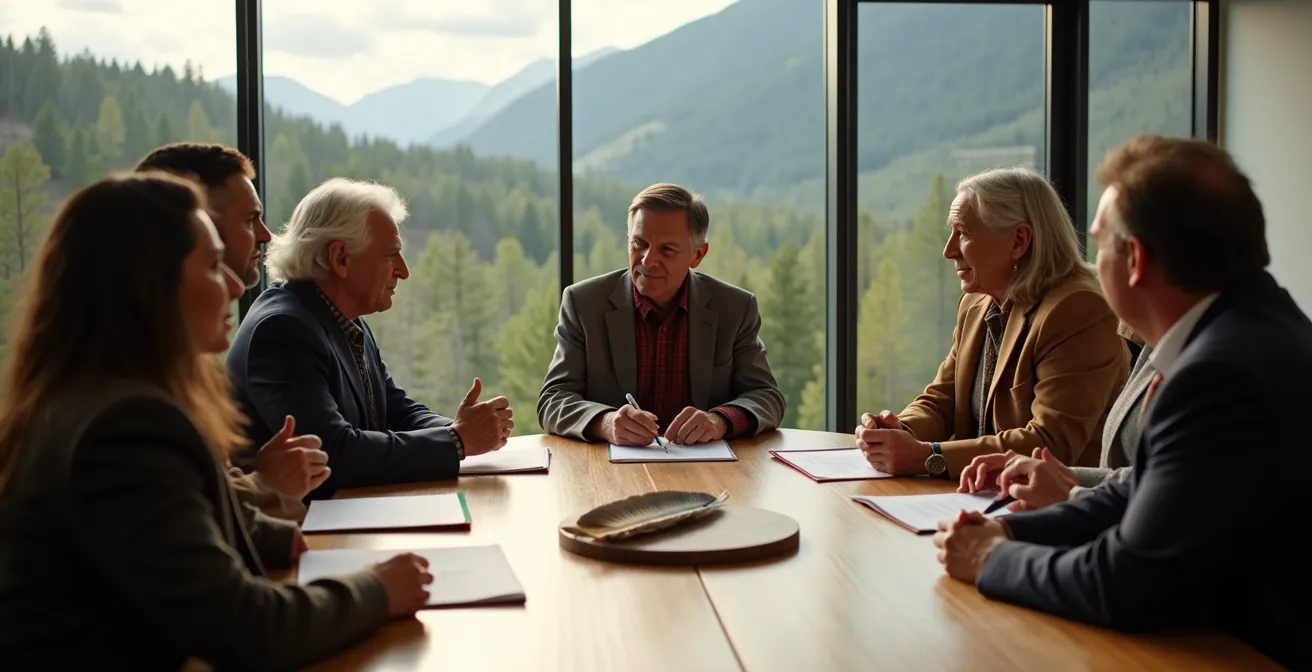
This image of Indigenous and corporate leaders working together on IBA documents symbolizes the collaborative spirit required for success. It’s about building a partnership, not just signing a contract.

As this visual suggests, the negotiation table should be a place of balance and reciprocity. Leading companies are now building next-generation IBAs that move far beyond financial compensation, embedding principles of sovereignty and stewardship directly into the project’s DNA.
Your Checklist for a Next-Generation IBA
- Capacity Funding: Include funds for the First Nation to hire its own legal and technical experts to level the playing field during negotiations.
- Data Sovereignty: Establish clauses that give the Nation ownership and control over environmental monitoring data collected on their territory.
- Co-Designed Guardian Programs: Create and fund Indigenous-led environmental stewardship programs for ongoing monitoring and land management.
- Mandatory Review Periods: Build in 5-year review clauses to ensure the agreement can adapt to the community’s changing needs and project impacts.
- Post-Closure Contracts: Guarantee preferential bidding or direct award contracts for reclamation and remediation work to Indigenous-owned businesses.
Equity Participation vs. Royalties: Which Model do First Nations Prefer?
The shift towards economic reconciliation has brought a critical question to the forefront: what is the best financial model for partnership? While royalties offer a predictable, low-risk income stream, they place the First Nation in a passive role, effectively a landlord collecting rent. Increasingly, many Nations are seeking equity participation—a direct ownership stake in the project itself. This model aligns perfectly with the principles of self-determination and sovereignty.
As Greg Ebel, President and CEO of Enbridge, stated regarding their strategy:
Enbridge’s commitment to advance Indigenous ownership opportunities related to our existing and growing energy assets underlines our efforts to be the First Choice partner for the communities we serve.
– Greg Ebel, President and CEO, Enbridge
Equity gives the First Nation a seat at the governance table, a voice in major decisions, and a share in the project’s long-term appreciation. While it involves higher risk and requires significant capital and governance capacity, it represents a move from being a stakeholder to a true business partner. This transition is fundamental to building a relationship based on mutual interest rather than transactional obligation. The choice between models depends entirely on the specific Nation’s goals, risk tolerance, and capacity, as a comparative analysis by the Business Council of Canada shows.
| Aspect | Equity Participation | Royalties Model |
|---|---|---|
| Decision-Making Power | Seat at the table, active governance role | Limited to no decision-making involvement |
| Risk Level | Higher risk, shares losses | Lower risk, guaranteed income stream |
| Capital Requirements | Requires upfront investment or financing | No capital investment needed |
| Long-term Value | Potential for significant appreciation | Fixed percentage, no upside potential |
| Alignment with Self-Determination | Strong – control over resources | Weak – passive recipient role |
The Protocol Error That Can Stall Your Resource Project for Months
In Indigenous relations, protocol is not optional—it’s the operating system for communication and respect. A seemingly minor procedural misstep can be interpreted as a profound sign of disrespect, derailing trust and stalling a project before technical discussions even begin. The most common error is a failure to recognize and follow the host Nation’s specific cultural protocols for engagement. This can be as simple as arriving at a first meeting empty-handed when the presentation of a traditional gift, such as tobacco, is expected as a sign of sincere intention.
This symbolic gesture, captured in the image of a respectful exchange, is more than a formality. It acknowledges a nation-to-nation relationship and sets the tone for all future interactions.

Ignoring these unwritten rules sends a clear message: you have not done your homework and do not value their ways. Success stories are often built on getting this right from day one. The East-West Tie Line, a 450-km transmission project, succeeded where others failed because the proponents, NextBridge Infrastructure, engaged multiple Indigenous communities with proper protocol from the outset. This early investment in relationship-building led to a shared ownership structure and prevented the costly delays that plague so many other major projects.
Case Study: East-West Tie Line Partnership
The 450-km electricity transmission line along Lake Superior’s north shore succeeded through NextBridge Infrastructure’s partnership, which brought together Enbridge, NextEra Energy Canada, and OMERS with Indigenous ownership. This project demonstrates how proper protocol and early engagement with multiple Indigenous communities prevented delays and created a shared ownership structure, providing immense project certainty.
Understanding protocol is not just a cultural courtesy; it’s a strategic imperative. It demonstrates a long-term commitment that goes beyond the legal minimums and aligns with the broader push for economic reconciliation, such as the federal government’s policy requiring a 5% minimum of federal contracts to be awarded to Indigenous-led businesses.
How to Build a Skills Training Program That Actually Hires Local Talent?
A common pledge in IBAs is a commitment to local Indigenous employment, often accompanied by a skills training program. However, many of these programs fail to translate into long-term careers. The “train and pray” model—where a generic course is offered without clear pathways to employment—creates disillusionment and is seen as another broken promise. A successful program must be demand-driven, co-designed with the community, and integrated directly into the company’s hiring pipeline.
The first step is to move away from generic “skills development” and focus on training for specific, in-demand jobs within the project. This involves a transparent analysis of the project’s labour needs over its entire lifecycle, from construction to operations and eventual closure. The training curriculum should then be co-created with the First Nation’s education department and leadership to ensure it is culturally appropriate and addresses potential barriers to participation, such as transportation, childcare, or academic upgrading.
The resource sector has demonstrated this is achievable. For example, data from Canada’s oil and natural gas industry shows a 26% increase, representing 2,900 new positions, in Indigenous employment between 2014 and 2019. This success is often tied to targeted, collaborative training initiatives. The motivation is clear, as noted by Statistics Canada:
Canada’s 2021 census showed that the extractive resource sectors provide the highest paying average wages for Indigenous workers in Canada.
– Statistics Canada, 2021 Census Data
The most effective models include wraparound supports and guaranteed interviews for program graduates. Some companies go further by creating mentorship programs that pair new Indigenous hires with senior employees to support retention and career progression. The goal is not just to get people in the door, but to build a local, skilled workforce that becomes a permanent, integral part of the operation, creating lasting value long after the initial training program ends.
How to Structure a Joint Venture with Western Indigenous Development Corporations?
As First Nations move towards economic self-determination, many have established sophisticated Indigenous Development Corporations (IDCs) to act as the business arm of the community. For a resource company, partnering with an IDC in a Joint Venture (JV) is one of the most powerful forms of partnership, creating full alignment of economic interests. This is far more than a subcontractor relationship; it’s a co-ownership model that requires rigorous due diligence and a structure built on true partnership.
The potential for these partnerships is immense. According to Canada Action, Indigenous people and businesses are already major players in the resource economy, with an estimated 39% of all Aboriginal businesses engaged in extractive industries, compared to less than 1% of all Canadian businesses. This highlights the deep experience and interest within communities for these types of ventures. An IDC is not simply a local company; it is often a highly strategic entity designed to generate own-source revenue to fund community programs and services, making the success of the JV critical to the Nation’s future.
Structuring a successful JV requires a clear-eyed assessment from both sides. Before entering into a partnership, a company must conduct thorough due diligence on the IDC’s capacity and governance. Key questions to ask include:
- Is the corporation majority-owned and controlled by the community it represents?
- Does it have a proven track record of successful governance and a professional board?
- Is there a clear Band Council Resolution (BCR) demonstrating community support for the venture?
- Does the IDC have the administrative and financial capacity to manage its side of the partnership?
A successful JV structure often includes clauses that ensure Indigenous management participation, prioritize hiring of community members, and contain a plan for phased-in capacity building. It transforms the relationship from client-contractor to one of fully aligned partners working toward a shared bottom line.
Why You Must Seek Elder Approval Before Commercializing Traditional Knowledge?
Traditional Knowledge (TK), also known as Indigenous Knowledge (IK), is a living and collective body of wisdom that encompasses environmental, spiritual, and cultural information passed down through generations. To a resource company, certain aspects of TK—such as information about medicinal plants, wildlife patterns, or ecological indicators—may seem like valuable “data” to be collected and used for environmental assessments or bioremediation. This perspective is a critical error and a form of intellectual property theft.
TK is not public domain information. It is the sovereign intellectual and cultural property of the community, and its use is governed by strict, unwritten protocols. The authority to share and interpret this knowledge often rests with specific knowledge keepers or Elders. Using TK without their explicit, prior, and informed consent is a profound violation of trust and cultural integrity. This misuse is sometimes referred to as ‘red washing’, a term highlighted in a recent submission to the Canadian Sustainability Standards Board.
Case Study: Anishinabek Business Professional Association (ABPA) and ‘Red Washing’
In 2024, the ABPA provided 18 recommendations to the Canadian Sustainability Standards Board, warning against ‘red washing’—when companies claim to support UNDRIP while having unresolved Indigenous infringement issues. The ABPA stressed that true sustainability reporting must require companies to actively seek and respectfully integrate Indigenous knowledge and cultural values, with the full consent of the knowledge holders, as a core part of data collection, not an afterthought.
Engaging with Traditional Knowledge requires a company to set aside its corporate mindset of data acquisition. The process should be community-led. The community must decide if knowledge will be shared, who is authorized to share it, how it can be used, and how the community will be compensated for its use. This often involves creating a formal TK protocol agreement that outlines these terms before any knowledge is shared. Seeking Elder approval is not a step in the process; it is the only legitimate gateway to a conversation about Traditional Knowledge.
Key Takeaways
- Partnership over Process: Shift from viewing consultation as a legal checklist to an opportunity for building a long-term, nation-to-nation relationship.
- Value Co-Creation: Structure IBAs and JVs to build community wealth and capacity (e.g., equity stakes, spin-off businesses) rather than just making transactional payments.
- Protocol is Paramount: Minor breaches in cultural protocol can cause major project delays. Invest time to learn and respectfully follow the specific protocols of your partner Nation.
Promoting Cultural Exploration: How to Develop Authentic Indigenous Tourism Experiences?
While a resource project’s primary focus is extraction, a truly holistic partnership looks at the full spectrum of economic opportunities that can benefit the partner Nation. Indigenous tourism is a rapidly growing sector that aligns with the values of cultural preservation and self-determination. For a resource company, facilitating or investing in a community-led tourism venture can be a powerful act of economic reconciliation, creating a positive legacy that extends far beyond the life of the mine or forestry operation.
The key to success, however, is authenticity and Indigenous control. The worst possible approach is for the company to attempt to create and manage a “cultural experience” itself. This invariably leads to appropriation and inauthentic products. As the Indigenous Tourism Association of Canada (ITAC) advises, the only viable model is one where the community is in the driver’s seat.
The most authentic model is one where the company acts as a facilitator, investor, or marketing partner for a tourism business that is 100% controlled by the community.
– Indigenous Tourism Association of Canada, ITAC Partnership Guidelines
This model positions the resource company as an enabler, not an operator. The company can provide seed funding, support business plan development, or leverage its corporate network for marketing, but the vision, stories, and management remain entirely with the First Nation. The scale of these ventures can be transformative, moving far beyond small-scale eco-tours.
Case Study: The Senakw Development in Vancouver
An inspiring example of Indigenous-led development is the Senakw project. This is a 6,000-unit residential and commercial development on Squamish First Nation lands in the heart of Vancouver. As the largest development on First Nation Reserve lands in Canada, it demonstrates how Indigenous communities can lead massive, modern urban projects that incorporate cultural design and values while creating immense economic opportunity for the Nation. It sets a new standard for urban development and tourism potential.
By supporting such ventures, a resource company helps build a diversified local economy that is not solely dependent on the project. This fosters goodwill, demonstrates a genuine commitment to the community’s long-term prosperity, and creates a powerful, positive narrative for investors and the public.
Ultimately, building successful Indigenous partnerships is a fundamental shift in corporate strategy. It requires moving from a mindset of risk management to one of shared opportunity, recognizing First Nations as sovereign economic partners with a right to determine the future of their lands and resources. For executives willing to lead this change, the reward is not just project certainty, but the chance to build a legacy of true economic reconciliation.