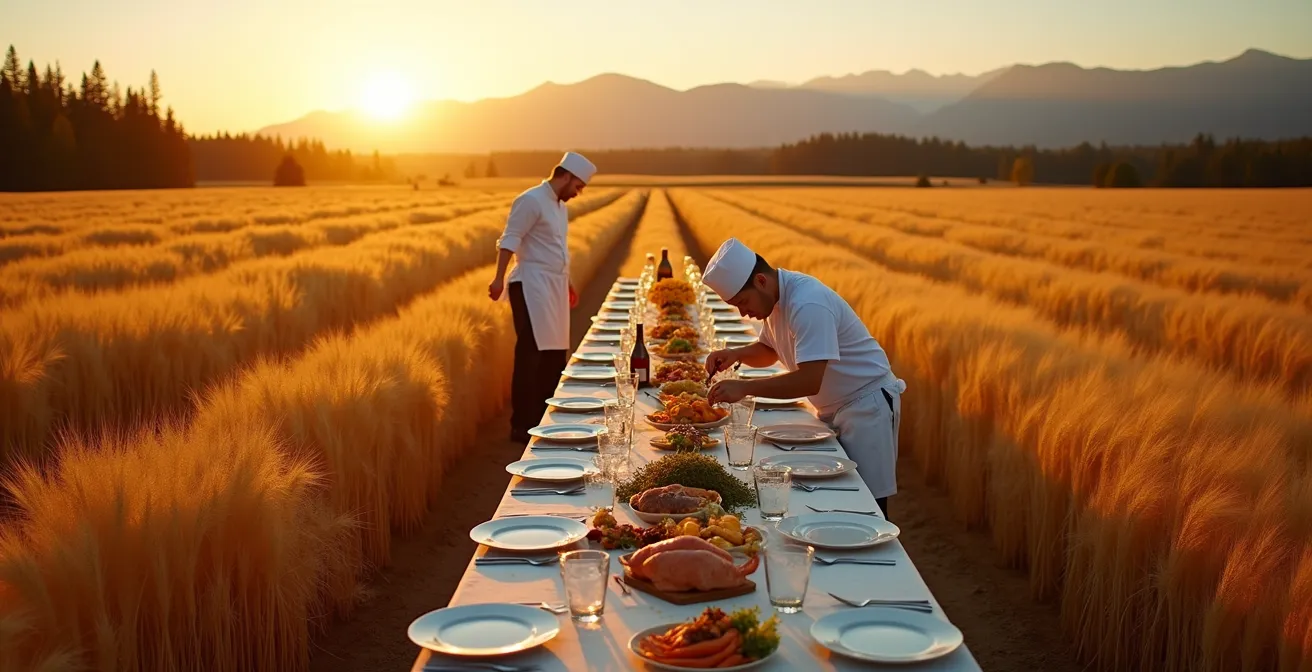
The key to attracting high-value culinary tourists isn’t just a better menu; it’s architecting a premium, narrative-rich “Taste of Place” that justifies a higher price point and creates year-round demand.
- Successful culinary destinations transform local products into compelling stories of origin and heritage.
- Strategic collaboration with competitors and smart navigation of grants and licensing are critical business levers, not administrative tasks.
Recommendation: Shift your focus from selling a product to curating an entire regional experience, leveraging local stories and partnerships to build an economic ecosystem that thrives beyond the peak season.
For a winery owner in the Okanagan or a tourism director in Niagara, the pressure is constant. The sun-drenched patios are full in August, but the quiet chill of November brings a familiar anxiety. You have a world-class product, yet you’re competing not just with the vineyard down the road, but with every other premier culinary destination on the planet for the attention of discerning, high-value travelers. The common advice feels tired: post more on social media, refresh your menu, host another wine festival. These are tactics, but they often fail to address the core strategic challenge.
These approaches treat your business as an island. They focus on the food and wine as a final product, rather than the start of a story. They might create a temporary spike in traffic, but they don’t build the deep, resilient economic foundation that defines a truly world-class culinary region. What if the path to attracting high-yield foodies and creating sustainable, year-round profitability wasn’t about doing more of the same, but about fundamentally changing the way you think about your place in the local ecosystem?
This guide moves beyond the plate to explore the essential strategies of experience architecture. We will demonstrate that true culinary tourism is about building a profitable, narrative-driven ‘Taste of Place’. It’s about understanding that a dollar spent locally has a multiplier effect, that a competitor can be your most valuable partner, and that a story well told is your most powerful asset. We will deconstruct the business models, licensing complexities, and marketing frameworks needed to transform your region into a destination that commands a premium and captivates travelers from around the globe.
This article provides a strategic roadmap for building a resilient and sought-after culinary destination. Explore the key pillars required to attract and retain high-value visitors, from crafting your unique story to navigating the practicalities of growth.
Summary: A Strategic Guide to Building a Culinary Destination
- Why Storytelling About Origin Justifies a Premium Price Point?
- How to Create a “Taste Trail” Passport with Competitors?
- Tasting Room vs. Full Restaurant: Which Model Maximizes Profitability?
- The Licensing Mistake That Shuts Down Your Patio Event
- How to Extend Culinary Tourism Revenue into the Shoulder Season?
- Why $1 Spent Locally Circulates 3x More Than $1 Spent at a Chain?
- Façade Improvement vs. Brownfield Remediation: Which Grant Has a Higher ROI?
- Attracting International Visitors: How to Market to the “High-Yield” Traveler?
Why Storytelling About Origin Justifies a Premium Price Point?
High-value travelers are not just buying a glass of wine or a meal; they are investing in an experience and a story. The concept of “Taste of Place”—or *goût du terroir*—is the engine of premium culinary tourism. It’s the narrative that connects the specific minerality of your soil, the unique microclimate of your valley, or the multi-generational history of your family farm to the distinct flavour profile of your product. This story provides an emotional resonance that generic products, no matter how high in quality, can never replicate. It transforms a commodity into a coveted piece of your region’s identity.
When you sell a story, you are no longer competing on price alone. You are offering exclusivity, authenticity, and a connection to a place. This is why a wine from a specific, named slope in the Okanagan can command a higher price than a generic blend, or why artisanal cheese from a historic Québec fromagerie feels more valuable. The story justifies the premium because it provides a value that transcends the physical product. It answers the “why”—why this place, why this producer, why this taste. It’s an investment in memorability.
Case Study: The Power of Ancestral Narratives in Indigenous Culinary Tourism
A powerful Canadian example is the work highlighted by Destination Indigenous and the Indigenous Culinary of Associated Nations. Chefs like the Squamish Nation’s Paul Natrall and Inuk chef Silla Flaherty aren’t just serving food; they are curating experiences steeped in ancestral practices and heritage. As showcased in the Nourished Lands project, they demonstrate how spiritual and cultural meanings are passed down through generations via culinary traditions. This deep storytelling elevates their offerings into premium cultural experiences, attracting visitors who seek authenticity and are willing to pay for a genuine connection to Canada’s First Nations and Inuit history, proving that heritage itself is a high-value ingredient.
Building this narrative requires a conscious effort to connect your product to the broader Canadian identity. It involves linking your family’s immigrant journey or your farm’s deep roots to universally recognized Canadian values like multiculturalism, pristine nature, and quality craftsmanship. By doing so, you create a powerful marketing asset that resonates with both domestic and international visitors seeking a genuine taste of Canada.
How to Create a “Taste Trail” Passport with Competitors?
The idea of collaborating with direct competitors can seem counterintuitive, but in destination marketing, a rising tide lifts all boats. A single winery is a stop; a collection of wineries, cideries, and farm stands linked by a cohesive “Taste Trail” is a destination. This collaborative approach creates a much larger draw, encouraging visitors to extend their stay and deepen their regional spending. A passport program—whether digital or physical—gamifies the experience, providing a clear itinerary and a sense of accomplishment that drives traffic to all participating businesses.
This strategy is particularly effective in the growing domestic market. As people explore their own backyards, they seek curated experiences. Statistics Canada reports that domestic tourism spending increased 1.3% in the fourth quarter of 2024, signaling a stable and engaged audience for local travel. A taste trail directly taps into this trend by making regional exploration easy and rewarding.
The key to success is moving from isolated businesses to a unified front. This requires forming a coalition and presenting a professional proposal to your Regional Tourism Organization (RTO), like the Culinary Tourism Alliance, or provincial bodies such as Destination BC or Travel Alberta. A unified proposal demonstrating cross-business collaboration and clear economic impact objectives is far more likely to secure support and potential matching funds.

A digital passport, as visualized here, enhances the user experience by offering seamless check-ins, rewards, and real-time updates. It transforms a simple tour into an interactive journey, collecting valuable data on visitor behaviour that can be used to refine the offering in future seasons. This is a prime example of effective experience architecture in action.
Tasting Room vs. Full Restaurant: Which Model Maximizes Profitability?
For a winery or craft producer, the decision to expand from a simple tasting room to a full-service restaurant is a critical strategic crossroads. Each model presents a distinct set of opportunities and challenges related to revenue, labour, licensing, and seasonality. A tasting room offers a high-margin, low-complexity environment focused on direct-to-consumer sales of your own product. It requires a smaller team and navigates simpler “tied house” licensing restrictions from bodies like Ontario’s AGCO or BC’s LCRB. However, its revenue potential is inherently limited, and it’s highly susceptible to seasonal downturns.
A full restaurant, by contrast, diversifies your revenue streams. It can attract a different clientele, generate income year-round, and act as a powerful marketing tool for your core products. The growth in this sector is steady; as noted by Statistics Canada, food and beverage services grew by 3.0% in late 2024. However, this potential comes with significantly higher labour costs, more complex food service licensing, and the operational demands of running a full kitchen. The choice is not simply about adding food; it’s about adopting an entirely different business model.
The following table breaks down the core trade-offs, helping you analyze which model best aligns with your brand, operational capacity, and long-term financial goals in the Canadian market.
| Model Aspect | Tasting Room | Full Restaurant |
|---|---|---|
| Revenue Growth Potential | Limited to own products | Diversified menu offerings |
| Labour Costs | Lower staffing requirements | Higher with full service team |
| Provincial Licensing Complexity | Tied house restrictions (AGCO/LCRB) | More flexibility in product offerings |
| Seasonal Impact | High seasonality risk | Year-round potential |
| Food Service Growth 2024 | +3.0% in Q4 2024 (Statistics Canada) | |
Ultimately, the “best” model depends on your strategic objectives. Are you aiming to maximize high-margin product sales with a lean operation, or are you building a comprehensive destination brand where the restaurant serves as a central pillar of the visitor experience? Answering this question is the first step toward sustainable profitability.
The Licensing Mistake That Shuts Down Your Patio Event
A sun-drenched patio dinner, a harvest long-table event, or a pop-up tasting in a vineyard are precisely the kinds of premium, memorable experiences that attract high-value foodies. However, the single biggest point of failure for these events is often not the food or the marketing, but a misunderstanding of provincial and municipal licensing. A last-minute discovery that your Special Occasion Permit is incomplete, or that you’ve violated a noise bylaw, can shut down your event, damage your brand reputation, and result in significant financial loss.
Regulatory navigation is a critical, non-negotiable competency for any serious culinary tourism operator in Canada. Each province has its own distinct regulatory body and timelines—the AGCO in Ontario, the LCRB in British Columbia, and the AGLC in Alberta, to name a few. Assuming a one-size-fits-all approach is a recipe for disaster. For example, a standard permit application in Ontario requires a minimum of 30 days, while Alberta’s can be as short as 10 business days, but each has different documentation requirements, such as floor plans or insurance certificates.
Furthermore, a liquor license is only one piece of the puzzle. An outdoor event can trigger the need for a cascade of other permits: municipal noise bylaw exemptions, fire code capacity permits for temporary structures like tents, and even temporary signage permits from the local planning department. Forgetting any one of these can be a critical failure point. A proactive, systematic approach to permitting is the only way to ensure your creatively planned event becomes a seamless, profitable reality.
Your Cross-Provincial Special Occasion Permit Checklist
- Liquor Permit: File with the correct provincial body (e.g., AGCO, LCRB, AGLC), respecting their specific lead times (10-30+ days) and documentation needs (floor plans, security details).
- Municipal Bylaws: Secure necessary exemptions for noise and temporary signage from your local municipal office well in advance.
- Structural & Fire Safety: Obtain fire code capacity permits for any tents or temporary structures and ensure your layout meets all safety regulations.
- Public Health: Verify that all staff handling food have current food handler certifications as required by your local public health unit.
- Insurance & Security: Confirm your event insurance is in place and that your security arrangements meet the requirements stipulated in your liquor permit application.
Treating this checklist as an integral part of your event planning process, rather than a last-minute administrative task, is the difference between a successful event and a costly cancellation.
How to Extend Culinary Tourism Revenue into the Shoulder Season?
The greatest challenge for most Canadian tourism businesses is seasonality. The vibrant peak season gives way to the quiet “shoulder seasons” of late fall and early spring, causing revenue to plummet. The most resilient culinary destinations, however, don’t fight the seasons; they embrace them. The key to shoulder season monetization is to reframe what your region has to offer, turning potential liabilities like cold weather into unique, premium assets.
Instead of closing up shop, the question should be: “What experience is only possible here, at this specific time of year?” This shift in mindset opens up a world of creative and profitable opportunities. It’s about creating events and products that have a built-in sense of urgency and scarcity, compelling visitors to travel during what they would normally consider the “off-season.”
This is where storytelling and climate converge to create pure marketing gold. These unique, season-specific products become a destination driver in their own right, attracting visitors who are specifically seeking these one-of-a-kind experiences. They are not settling for the off-season; they are travelling for it.
Case Study: Turning Winter into Gold in Niagara and Québec
Two iconic Canadian examples demonstrate this principle perfectly. In Niagara, the frosty winters are not a bug, but a feature. They are the essential ingredient for producing world-class icewine, a premium product that has become synonymous with the region’s identity. The Niagara Icewine Festival, held in January, transforms the coldest part of the year into a peak tourism moment. Similarly, in Québec, the spring thaw is not just the end of winter; it’s the start of the maple syrup season. As Destination Canada eloquently puts it, it’s a time when “spring tastes like tradition.” Sugar shacks become bustling destinations, celebrating a uniquely Canadian culinary ritual. Both regions have successfully turned their specific climate conditions into powerful, revenue-generating tourism drivers during traditionally slow periods.
By identifying your region’s unique seasonal assets—whether it’s the fall harvest, the first snowfall, or the spring thaw—you can develop signature experiences that create new revenue streams and build a more financially stable, year-round business model.
Why $1 Spent Locally Circulates 3x More Than $1 Spent at a Chain?
While the “3x” figure is a well-known axiom in local economic theory, the underlying principle for culinary tourism in Canada is concrete and measurable. When a visitor spends money at a locally-owned winery, restaurant, or farm shop, that dollar doesn’t just disappear. It sets off a chain reaction—a powerful economic multiplier that strengthens the entire regional economy. The business owner uses that revenue to pay local employees, buy supplies from neighbouring farms, hire a local marketing firm, and pay provincial and municipal taxes. This is a stark contrast to spending at a national chain, where a significant portion of revenue is immediately extracted from the community to a corporate head office elsewhere.
This multiplier effect is not just a feel-good story; it’s a critical data point for tourism boards and operators when seeking public support and funding. Demonstrating how your culinary tourism business acts as an economic engine for the region makes a compelling case for investment. The data from Statistics Canada is clear: tourism is a significant source of government revenue, which in turn funds public services that benefit the entire community.
Tourism contributed $29.6 billion to government revenue in 2023, up 12.8% from 2022. Federal, provincial and territorial governments collected 93.7% of the government revenue generated by tourism. Taxes on products sold to final consumers ($15.2 billion) were the largest source, followed by corporate and individual income tax ($6.8 billion).
– Statistics Canada, National Tourism Indicators Q2 2024
This data powerfully illustrates the cycle. Tourism spending leads directly to tax revenue, which funds the very infrastructure and services that make a region attractive to live in and visit. In fact, further analysis shows that for every $100 in tourism spending, $26.16 is generated in government revenue. By championing your role in this virtuous cycle, you position your business not just as a private enterprise, but as a vital partner in regional prosperity.
Façade Improvement vs. Brownfield Remediation: Which Grant Has a Higher ROI?
For many culinary businesses, the question isn’t whether to seek funding, but which grants to pursue. The landscape can be complex, with options ranging from small-scale municipal façade improvement grants to larger federal programs for significant redevelopment. While a façade grant offers a quick, visible upgrade, its ROI is often limited to curb appeal. A more strategic approach involves grant stacking—layering multiple sources of funding to finance a transformational project with a much higher long-term return on investment.
The strategy is to start at the federal level with Regional Development Agencies like PrairiesCan or FedDev Ontario. These agencies often have mandates to support key sectors like tourism. For example, the Canadian Experiences Fund (CEF) was designed to invest in businesses that “showcase Canada’s strengths,” explicitly naming “farmers, ranchers and culinary artists who create farm-to-table experiences” as key players. Securing a federal grant provides more than just capital; it acts as a government ‘stamp of approval’ that significantly boosts your credibility when applying for subsequent funding.
With a federal grant secured, you can then “stack” additional funds: provincial value-added agriculture grants for new equipment, and municipal tourism infrastructure grants for signage or accessibility improvements. This creates a powerful financial synergy, enabling ambitious projects—like transforming an old barn into a modern agritourism facility—that would be impossible with a single grant. Federal bodies have made substantial targeted investments, with examples like PrairiesCan investing nearly $100,000 each into businesses like Prairie Gardens and Eau Claire Distillery, demonstrating the potential of this approach.

This visual transformation from a weathered rural structure to a polished culinary destination is a testament to the power of strategic grant stacking. It’s a physical manifestation of a business’s evolution, funded by a smart and layered approach to public-private partnership, delivering a far greater ROI than a simple coat of paint.
Key Takeaways
- Shift from selling a product to marketing a story. Authenticity and a strong ‘Taste of Place’ narrative are what justify a premium price to high-value travelers.
- View your local competitors as potential collaborators. A unified ‘Taste Trail’ or regional experience is a more powerful destination driver than any single business.
- Embrace seasonality as a strategic asset. Develop unique, premium experiences that are only possible during the shoulder seasons to create year-round demand.
Attracting International Visitors: How to Market to the “High-Yield” Traveler?
With international travel to Canada rebounding strongly, the opportunity to capture the lucrative high-yield traveler market is immense. These are not budget tourists; they are experienced travelers who seek unique, high-quality, and immersive experiences, and they are willing to pay for them. Reaching this demographic requires a marketing strategy that is more sophisticated than general advertising. It’s about strategic partnerships and targeted content that places your experience in front of the right eyeballs on a global stage.
The momentum is undeniable. According to the latest data from Statistics Canada, tourism spending by international visitors increased 8.0% in 2024, recovering to 92.3% of pre-pandemic levels. The market is back, and it’s competitive. To stand out, Canadian operators need to align with globally recognized platforms and brands that already have the trust and attention of this discerning audience. This means thinking beyond your own social media channels and collaborating with major players in the food and travel media space.
By partnering with established voices and platforms, you leverage their credibility and reach to tell your story to a qualified international audience. It’s about borrowing authority to build your own, and it’s one of the most effective ways to put a smaller Canadian region on the global culinary map.
Case Study: Destination Ontario’s “50 Best Explores” Global Campaign
A prime example of this strategy in action is the collaboration between the Culinary Tourism Alliance, Destination Ontario, and Destination Canada for the “50 Best Explores Ontario” campaign. By partnering with The World’s 50 Best, a globally revered culinary authority, they were able to produce a high-quality mini-documentary series showcased across YouTube, Facebook, and Instagram. This campaign successfully reached a massive global audience, with a significant portion located in the United States—a key target demographic. This partnership allowed Ontario’s culinary story to be told through a trusted, prestigious third-party channel, effectively marketing the province as a world-class food destination to high-yield international travelers.
For a winery in Niagara or an RTO in the Okanagan, the lesson is clear: identify the global media brands that your ideal customer trusts, and find creative ways to partner with them to showcase your unique Canadian “Taste of Place.”
Begin today by auditing your region’s unique story and identifying one key partner—be it a neighbouring business, a provincial RTO, or a media outlet—to start building your own ‘Taste of Place’ ecosystem and attracting the high-value visitors you deserve.