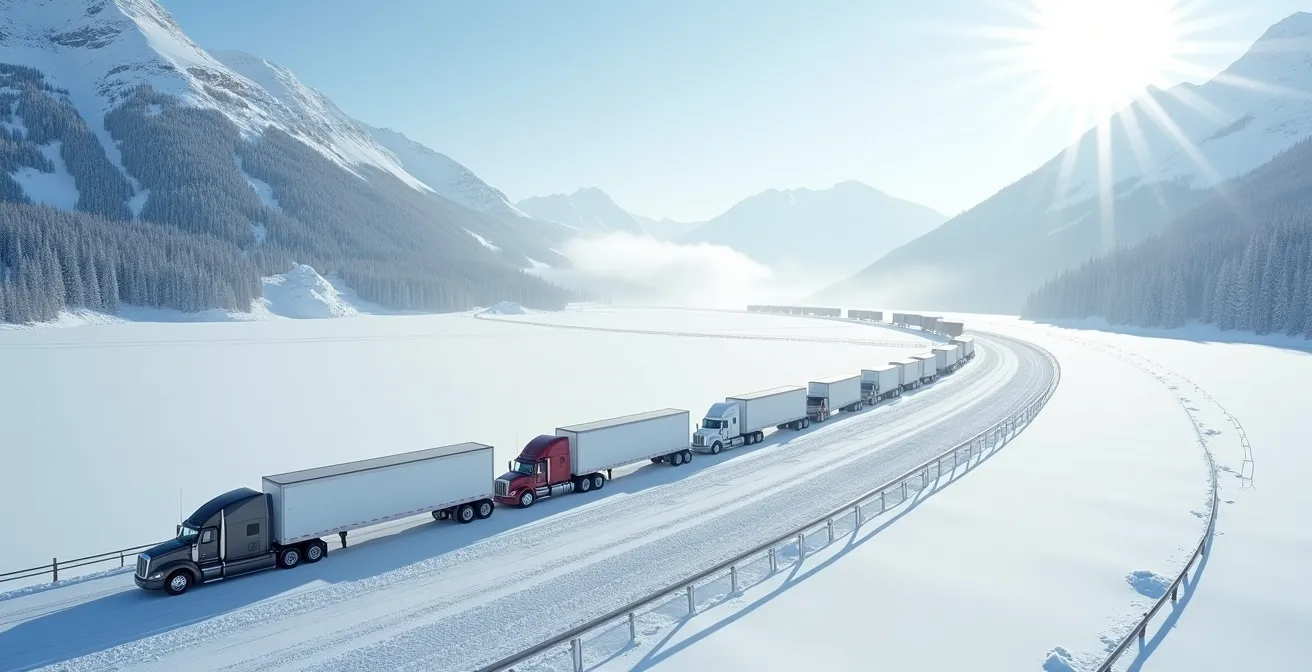
The key to surviving Canadian winter logistics isn’t reacting to storms, but building systemic resilience so that disruptions become predictable, manageable events.
- Winter’s financial impact comes from volatility; stabilizing transit times through multi-modal strategies is more critical than chasing the fastest possible speed.
- A “Plan B” route isn’t an emergency measure; it’s a pre-vetted, integrated part of your primary operational roadmap.
Recommendation: Shift your focus from seasonal preparation to engineering a year-round, resilient logistics network that treats winter as a known variable, not a surprise threat.
For any logistics director in Canada, the first heavy snowfall isn’t just a change in weather; it’s the start of an annual operational battle. Every year, we hear the same advice: check your tires, watch the forecast, and tell your clients to expect delays. This is the language of hope, not strategy. It’s the talk of someone reacting to winter, not commanding their supply chain through it. This passive approach is a direct route to bleeding cash, breaking client trust, and burning out your team. The real cost of winter isn’t just a stalled truck; it’s the cascading impact of unreliability across your entire network.
The standard playbook focuses on vehicle readiness and reactive scheduling. But what if the fundamental problem isn’t the snow, but the brittleness of our logistics models? The truth, learned over decades of watching rookie mistakes and calculating the cost of downtime, is that you can’t fight winter. You have to design a system that makes it irrelevant. This guide is built on that single, rugged principle: winter isn’t a surprise event; it’s a recurring operational condition.
We’re going to move beyond the platitudes. Instead of just preparing for delays, we will build a framework for operational resilience. This article provides a roadmap to re-engineer your logistics strategy, focusing on systemic redundancy, proactive de-risking, and turning winter from an unpredictable threat into a calculated part of your business model. We will analyze the true costs, build resilient routing plans, dissect transport modes, and implement the maintenance and staffing systems that separate the amateurs from the professionals who deliver, no matter what the thermometer says.
To navigate this complex terrain, this article is structured to build your winter resilience layer by layer. The following sections provide a clear path from understanding the financial stakes to implementing multi-modal solutions that create a truly robust supply chain.
Summary: A Roadmap for Winter Logistics Resilience
- Why Winter Delays Cost Canadian Carriers $100M Annually?
- How to Create a “Plan B” Route for when the Trans-Canada Highway Closes?
- Rail vs. Truck: Which is More Reliable During the Spring Thaw?
- The Maintenance Oversight That Leaves Trucks Stranded at -30°C
- How to Staff Your Warehouse for the Holiday Rush vs. the January Slump?
- Why Rail is Slower but More Reliable for Non-Perishable Goods in Winter?
- How to Manage Shipping Costs When Serving Remote Northern Communities?
- Multi-Modal Transportation in Canada: How to Reduce Shipping Costs by 20%?
Why Winter Delays Cost Canadian Carriers $100M Annually?
The nine-figure cost of winter isn’t a single invoice; it’s a death by a thousand cuts. It’s the overtime pay for rerouted drivers, the fuel burned idling in a highway closure, the penalty clauses triggered by missed delivery windows, and the immeasurable cost of lost customer confidence. While headline-grabbing events show the potential for massive disruption, winter inflicts a chronic, predictable financial drain. We see it in microcosm during other supply chain shocks; during recent cross-border mandates, for instance, a capacity reduction of just 16% of truckers caused costs to transport U.S. produce into Canada to rise by 50%. Winter creates a similar, recurring capacity crunch, but on a national scale.
The core issue is the cost of volatility. When a client can’t be sure if a shipment will take four days or eight, they can’t manage their own inventory or production schedules. This unreliability forces them to carry expensive safety stock, and eventually, to look for a more dependable logistics partner. The direct costs of delays are significant, but the indirect cost of being perceived as an unreliable partner is catastrophic. Every stalled truck is a moving advertisement for your competitor’s more resilient network.
Calculating this cost requires looking beyond the fuel and wages. It involves modeling the financial impact of service level agreement (SLA) failures, the cost of holding buffer inventory at your own facilities, and the long-term revenue erosion from customer churn. When you quantify this total cost of volatility, investing in systemic redundancy is no longer an expense—it’s a high-return investment in profitability and market share.
How to Create a “Plan B” Route for when the Trans-Canada Highway Closes?
The Trans-Canada is the backbone of our country, but in winter, it’s a notoriously fragile one. A single jack-knifed truck on the Coquihalla or a whiteout north of Superior can sever logistics for half the country. A “Plan B” isn’t a frantic scramble when the closure alert comes; it’s a pre-vetted, pre-costed, and system-integrated alternative. This is a core tenet of operational resilience. For every critical lane, your team must have an established and documented secondary, and sometimes tertiary, route.
This means going beyond simply looking at a map. It involves a detailed operational plan for each alternative. For example:
- Northern Ontario Corridor: When Highway 17 closes, the default alternative is Highway 11. Your plan must include designated fuel stops, driver rest areas, and communication protocols specific to this route.
- B.C. Mountain Passes: When the Coquihalla (Highway 5) is impassable, the Crowsnest Highway (Highway 3) is the primary alternative. Your plan must account for the different grades, slower speeds, and service limitations of this route.
A robust plan also includes proactive communication. Your system should automatically notify recipients of a reroute and provide an updated ETA the moment a driver is diverted. This transparency turns a potential service failure into a demonstration of professional management. The goal is to make the switch to Plan B so seamless that it’s a non-event for the client.

As this planning process shows, true routing strategy is not about finding the shortest path, but about identifying the most resilient network of paths. It requires a deep understanding of regional infrastructure and conditions, turning the map from a simple guide into a strategic playbook. Your track-and-trace applications become critical, logging each milestone to confirm the new plan is being executed flawlessly and keeping all stakeholders informed.
Rail vs. Truck: Which is More Reliable During the Spring Thaw?
Just as the deep freeze begins to loosen its grip, a new challenge emerges: the spring thaw. As the ground softens, provincial governments impose strict road weight restrictions to prevent catastrophic damage to our highway infrastructure. For heavy-haul and full-truckload freight, this period can be even more disruptive than a blizzard. Axle weight limits can slash a truck’s legal payload, forcing what was one shipment into two, and doubling costs overnight. This is where the “Thaw Equation” comes into play, and rail often emerges as the clear winner for reliability.
While rail is not immune to spring challenges like track washouts from rapid snowmelt, it is completely insulated from axle weight restrictions. A railcar carries the same tonnage in April as it does in July. For industries like forestry, mining, and machinery, which move immense weight, rail becomes the only viable option for maintaining throughput during the thaw season. For logistics directors, this makes rail a critical tool for de-risking spring supply chains.
The decision requires a clear-eyed comparison of the two modes during this specific operational window. The following analysis, based on insights from a comprehensive study of Canadian transport logistics, breaks down the key factors.
| Factor | Rail Transport | Truck Transport |
|---|---|---|
| Weight Restrictions | No axle weight limits | Significant load reductions during thaw |
| Route Vulnerability | Track washouts from snowmelt | Road closures and weight restrictions |
| Heavy-Haul Capability | Optimal for forestry/machinery | Limited by provincial restrictions |
| Transit Time Consistency | 7-9 days regardless of conditions | 3-4 days summer, 7+ days winter |
Ultimately, the spring thaw forces a strategic trade-off. Trucking might offer speed when roads are clear and loads are light, but rail offers consistency and payload integrity when the ground is soft. For non-perishable goods with predictable demand, using rail during the thaw is a powerful strategy to maintain supply chain velocity and avoid the costly disruptions of road restrictions.
The Maintenance Oversight That Leaves Trucks Stranded at -30°C
There is no more lonely or dangerous place than the cab of a dead truck on a prairie highway at thirty below. In almost every case, the failure wasn’t an unpredictable catastrophe; it was an oversight in the yard days before. In extreme cold, standard maintenance isn’t enough. You need a dedicated, rigorous winterization protocol that is treated with the seriousness of a pre-flight check. It’s a hard-learned lesson that trucks regularly face breakdowns in -40°C temperatures, where even simple mechanical failures can become life-threatening situations and lead to costly, complex recovery operations.
The most common failure points are infuriatingly predictable: fuel gelling, dead batteries, and frozen air lines. These are not acts of God; they are failures of process. A robust winter maintenance program moves beyond just checking fluid levels and becomes an audit of the vehicle’s ability to survive extreme cold. This isn’t about trusting drivers to do a quick walk-around; it’s about a systematic, documented process of proactive de-risking before the asset is dispatched into a hostile environment.
Implementing a mandatory pre-departure audit is non-negotiable. It transforms assumptions into verifications, creating a chain of accountability from the mechanic to the dispatcher to the driver. This isn’t just another piece of paperwork; it’s the barrier between a successful run and a frozen asset.
Action Plan: The Pre-Departure Winter Rig Audit
- Fluid & Fuel Systems Audit: Verify all winter-grade fluids (engine oil, coolant, washer fluid) are at correct levels and confirm that diesel fuel has been treated with the appropriate anti-gel additives for the expected temperature range.
- Electrical Systems Stress-Test: Conduct a load test on the batteries to verify cranking power and confirm the block heater is fully functional before the driver is dispatched. A weak battery at -5°C is a dead battery at -30°C.
- Driver Survival & Safety Kit Inspection: Manually inventory every cab for mandatory emergency equipment. This includes, at a minimum: reflective triangles, a full set of warm clothing (boots, gloves, parka), and a 72-hour supply of non-perishable food and water.
- Visibility & Access Equipment Check: Confirm the rig is equipped with a serviceable snow shovel, an effective ice scraper, and a brush. All lights, reflectors, and windows must be cleared of ice and snow before leaving the yard.
- Final Go/No-Go Sign-off: The driver and dispatcher must perform a final pre-trip verification against this checklist and formally log the sign-off in the system. This confirms the unit is fit for winter service.
How to Staff Your Warehouse for the Holiday Rush vs. the January Slump?
The pendulum of seasonal volume swings more violently in Canada than almost anywhere else. The frantic, all-hands-on-deck chaos of the pre-holiday peak in November and December gives way to the echoing silence of the January slump. Managing staffing through this cycle is a major operational and financial challenge, especially in a tight labor market. Recent data shows the challenge: even with fluctuating freight volumes, the Canadian trucking and logistics sector’s unemployment rate fell to a slim 3.2%, indicating a constant competition for skilled labor.
Relying solely on seasonal temps for the peak is a short-term fix with long-term costs: lower productivity, higher training overhead, and increased risk of errors and safety incidents. A more resilient strategy involves a core team of permanent staff supplemented by a flexible, well-managed system. The key is to treat the January slump not as downtime, but as strategic upskilling time. This is your prime opportunity to invest in your core team, turning a period of low volume into a high-value investment in your workforce’s capability.

During this slower period, focus on cross-training your most reliable workers. The forklift operator learns the warehouse management system (WMS). The picker gets certified on new equipment. The shipping clerk learns receiving. This investment accomplishes three critical goals:
- It builds a flexible workforce: When the next peak hits, you have a team that can dynamically shift roles to attack bottlenecks, reducing your reliance on expensive and less-efficient temporary labor.
- It increases employee retention: Investing in your team’s skills is a powerful retention tool in a competitive market. It shows a commitment to their career growth beyond a simple hourly wage.
- It improves operational quality: A more skilled, more engaged core team makes fewer mistakes, improves safety, and drives a better customer experience year-round.
This approach smooths out the peaks and valleys of seasonal demand, creating a more stable, efficient, and resilient warehouse operation.
Why Rail is Slower but More Reliable for Non-Perishable Goods in Winter?
In logistics, we are conditioned to chase speed. But in the Canadian winter, the relentless pursuit of the fastest transit time can be a trap. A single weather event can turn a 4-day truck journey into a 10-day nightmare, throwing schedules into chaos. For non-perishable goods with a steady, predictable demand, the smarter play isn’t speed; it’s predictability. This is where rail demonstrates its immense strategic value. An analysis of Canadian transportation modes shows that while truck transit can vary wildly from 3-4 days in summer to over 7 days in winter, rail transit holds steady at a predictable 7-9 days, regardless of the weather on the ground.
This consistency transforms the entire logistics equation. When you can confidently plan for a 9-day transit, you can adjust inventory levels and production schedules accordingly. The volatility is removed. It’s a fundamental shift in mindset, eloquently captured by industry experts who have studied the trade-offs in northern logistics. As one analysis notes:
Rail removes the weather-related volatility from the ETA, turning longer transit time into a mobile warehouse that can reduce expensive warehousing space at the destination.
– BBE Logistics Analysis, Winter Road vs Air Freight Study
This concept of the “mobile warehouse” is a powerful tool for proactive de-risking. By shipping goods via rail two weeks before they are needed, you are effectively using the rail network as rolling storage. This reduces the need for costly warehousing space at the destination and, more importantly, decouples your supply chain from the whims of winter weather. The shipment will arrive within a reliable window, protected from the blizzards and road closures that plague its truck-bound counterparts. For the right kind of freight, trading a few days of speed for near-perfect predictability is one of the smartest strategic decisions a logistics director can make.
How to Manage Shipping Costs When Serving Remote Northern Communities?
Logistics in Canada’s North is a different universe. The distances are vast, the infrastructure is sparse, and the operational windows are unforgivingly short. Here, winter isn’t just a challenge; for many communities, it’s the *only* viable season for receiving bulk goods via temporary winter roads, often called ice roads. These frozen lifelines operate for just a few weeks or months a year. If a company misses that window to move equipment or supplies that are too large for air transport, it could be another full year before they get a second chance. The cost of failure isn’t a delay; it’s a total service breakdown for six months or more.
Managing costs in this environment requires a hyper-specialized strategy that blends government programs, strategic partnerships, and meticulous planning. Simply applying southern logistics models is a recipe for financial disaster. Success depends on leveraging every available efficiency and building a deep understanding of the unique northern operating environment.
Effective cost management strategies include:
- Leveraging Subsidies: Registering as a supplier for Canada’s Nutrition North program is a critical first step for any company shipping food and other essentials, as it provides subsidies to offset the extreme transportation costs.
- Strategic Pre-staging: Instead of shipping directly from the south, establish pre-staging resources at key northern hubs like Edmonton, Winnipeg, or Yellowknife. This allows for freight consolidation closer to the final destination.
- Local Partnerships: Partnering with Indigenous-owned logistics companies provides invaluable local knowledge, access to a local workforce, and helps navigate the complex social and geographical landscape.
- Freight Consolidation: For ice road journeys, the goal is always a full truckload. Work with other companies and local partners to consolidate freight and maximize the efficiency of every single truck that makes the perilous journey.
- Sealift Coordination: For communities accessible by sea, all planning must revolve around the short operational windows of the Eastern and Western Arctic Sealifts, which are the primary method for moving bulk goods and heavy equipment.
In the North, logistics is a community effort. Collaboration and long-range planning are not optional; they are the only way to provide reliable service while managing the astronomical costs.
Key Takeaways
- Resilience Over Speed: The goal of winter logistics is not to be the fastest, but to be the most predictable. Reliability is the ultimate currency.
- Systemic Redundancy is Standard: Alternative routes, modes, and suppliers should be built into your primary operational plan, not kept in an emergency binder.
- Winter is a Known Variable: Stop treating winter as a surprise. Engineer your systems, maintenance protocols, and staffing models to account for it as a recurring operational condition.
Multi-Modal Transportation in Canada: How to Reduce Shipping Costs by 20%?
We’ve dissected the individual components of a resilient winter strategy: robust routing, smart maintenance, and a strategic embrace of rail. The final step is to integrate these elements into a cohesive, cost-effective system. This is the power of multi-modal transportation. It’s not about choosing truck *or* rail; it’s about using the right mode for the right leg of the journey to create a whole that is more efficient and resilient than the sum of its parts. By combining the flexibility of short-haul trucking with the long-haul efficiency of rail, a 20% reduction in shipping costs is not an optimistic projection; it’s an achievable operational goal.
The classic model involves using trucks for the first and last miles—picking up from the origin and delivering to the final destination—while leveraging rail for the long, cross-country portion. This model optimally plays to each mode’s strengths. Trucks provide the door-to-door flexibility that rail can’t, while rail provides unmatched fuel and labor efficiency over vast distances, insulated from weather delays, driver shortages, and highway closures. Critical intermodal hubs in locations like Brampton, ON, Calgary, AB, and Prince Rupert, BC, become the strategic heart of this network, enabling the seamless transfer of goods.
This approach directly attacks the primary cost drivers of winter trucking. It minimizes the miles driven on treacherous, fuel-guzzling winter highways and reduces the reliance on long-haul drivers in a perpetually tight market. The cost structure becomes more stable and predictable, directly combating the cost of volatility that erodes margins.
| Transportation Method | Cost Factor | Efficiency Rating |
|---|---|---|
| All-truck coast-to-coast | High fuel costs + driver wages + weather delays | 60% efficiency |
| Multi-modal (truck-rail-truck) | Short-haul truck + efficient rail + final mile | 80% efficiency |
| Key Intermodal Hubs | Brampton (ON), Calgary (AB), Prince Rupert (BC) | Critical transfer points |
Implementing a multi-modal strategy requires a shift in planning from managing individual shipments to designing an integrated logistics flow. It demands strong partnerships with both rail and drayage carriers. But the payoff is a supply chain that is not only more cost-effective but fundamentally more resilient to the pressures of a Canadian winter.
The principles outlined here are not theoretical. They are proven, field-tested strategies for transforming your logistics operation from a reactive victim of winter to a resilient, reliable market leader. The next step is to move from understanding to implementation. Begin by auditing your current winter contingency plans against this framework and identify the most critical point of failure to address first.