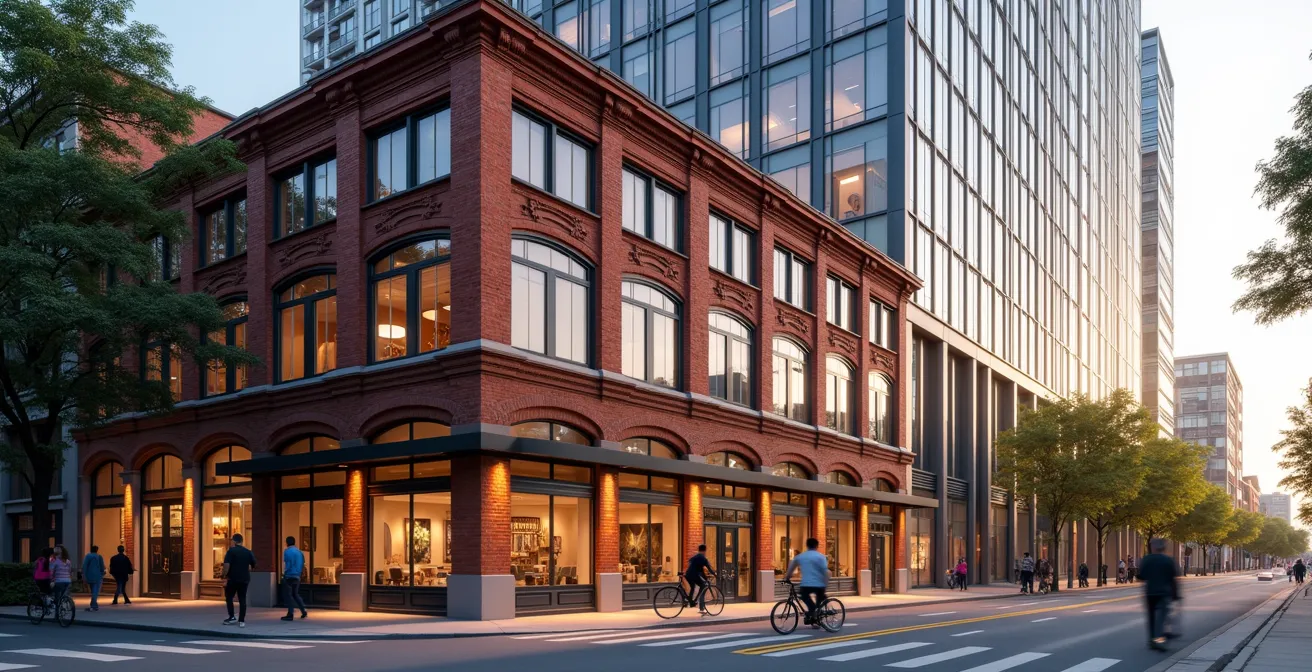
A heritage designation in Canada is not a development obstacle but a strategic financial framework that unlocks superior ROI when approached as an asset repositioning strategy.
- Regulatory “burdens” are gateways to exclusive financial instruments like density bonusing and stacked municipal grants unavailable for new builds.
- Advanced building science allows for modern energy performance in historic structures without compromising the crucial character-defining elements that drive value.
Recommendation: Shift your perspective from preservation costs to leveraging the heritage framework as a competitive advantage to create a premium, profitable commercial asset.
For a real estate developer, the sight of a “heritage designated” property can trigger a cascade of concerns: regulatory nightmares, budget-breaking restoration costs, and severe design constraints. The conventional wisdom dictates caution, framing these buildings as liabilities saddled with expensive obligations. Many developers see only the red tape and the perceived impossibility of integrating modern business needs—like open-concept offices or high-efficiency HVAC—into a structure built for a different century.
This perspective, while common, is fundamentally flawed. It views heritage conservation through the narrow lens of preservation costs rather than the wide-angle view of strategic investment. The truth is that the Canadian heritage system, from the municipal to the federal level, has evolved. It is no longer just about preserving the past; it’s about incentivizing its future. The most successful developers are those who stop seeing designation as a death sentence and start seeing it as an exclusive financial toolkit.
But what if the very regulations you fear are actually levers for profit? What if that heritage designation unlocks access to a suite of grants, tax incentives, and zoning variances that make the project more financially viable than a standard new build? This is the core of modern heritage development: treating the building not as a museum piece, but as an asset class with its own unique rules for maximizing returns. It’s a shift from simple restoration to strategic asset repositioning.
This guide will deconstruct that strategy. We will explore how to navigate the approval process for modern upgrades, analyze the financial trade-offs between restoration and façadism, and identify the critical technical mistakes to avoid. Ultimately, you will learn to leverage Canada’s heritage framework to build projects that are not only culturally significant but exceptionally profitable.
Summary: A Developer’s Guide to Repurposing Canada’s Heritage Buildings
- Why a “Heritage Designation” Isn’t a Death Sentence for Development?
- How to Get Approval for Modern Upgrades in a Historic Façade?
- Restoration vs. Façadism: Which Approach is More Financially Viable?
- The Foundation Mistake That Blows Your Renovation Budget by 50%
- How to Insulate a Brick Heritage Building Without Damaging the Masonry?
- Why Your Building Renovation Might Qualify for a Tax Increment Grant?
- When to Upgrade Equipment to Maximize New Green Building Grants?
- Leveraging Local Economic Incentives: How to Access Municipal CIP Grants?
Why a “Heritage Designation” Isn’t a Death Sentence for Development?
The initial reaction to a heritage designation is often one of financial dread. However, this view overlooks a crucial reality: designation is the key that unlocks a dedicated and often lucrative stream of financial instruments. In Canada, this is formalized across three tiers of government. At the federal level, designation can grant access to programs like the National Cost-Sharing Program for Heritage Places, which provides direct funding assistance to owners. This isn’t a barrier; it’s a partnership.
Provincially and territorially, buildings can gain designations like ‘Provincial Historic Resource’, governed by acts that often come with their own funding and advisory support. The most impactful level for most developers, however, is municipal. A listing on a local heritage register is a direct signal to investigate that municipality’s Community Improvement Plan (CIP), which frequently includes grants, loans, and tax incentives specifically for designated properties. This transforms the designation from a restrictive label into an invitation to access capital.
Viewing designation as a “death sentence” is a strategic error. It is, in fact, the entry ticket to a system designed to encourage and financially support the very work of adaptive reuse. The regulations are not there to stop development but to guide it in a way that allows the community to retain its character while enabling property owners to create viable, modern uses. The savvy developer understands this and factors these exclusive financial instruments into their pro forma from day one, often finding that the net cost of renovation is significantly lower than initially feared.
How to Get Approval for Modern Upgrades in a Historic Façade?
Integrating modern elements into a historic façade is a delicate negotiation, not an outright battle. Success hinges on a proactive, collaborative approach with municipal heritage authorities, rather than a confrontational one. The key is to demonstrate that your proposed alterations respect the building’s character-defining elements—those specific features that make it historically significant—while allowing for viable contemporary use. This process is formalized through a Heritage Impact Assessment (HIA).
Before you even draft detailed plans, the first step is to engage the local Heritage Officer. These individuals are not adversaries; they are your primary resource for navigating the specific by-laws of their jurisdiction, from the Ontario Heritage Act to Vancouver’s distinct policies. They can provide invaluable early feedback that prevents costly redesigns later. The HIA is your central tool in this dialogue, a document that justifies your project by showing a deep understanding of the building’s history and a thoughtful plan for its future.

As seen in the collaborative process, success requires meticulous preparation. Your HIA must be comprehensive, including detailed photography, material specifications that match historical precedents, and 3D renderings that clearly visualize the impact of proposed changes from key public viewpoints. This transparency builds trust and shows a commitment to a high-quality outcome. Energy efficiency upgrades, such as new windows or solar panels, are often permissible if their aesthetic impact is minimized and the authorities are informed proactively.
Your Action Plan: Preparing a Heritage Impact Assessment
- Engage a local Heritage Officer who can guide you through regulations and help create a compliant renovation plan.
- Document existing conditions with detailed photography and measurements of all character-defining elements.
- Create 3D renderings showing proposed changes from multiple street views to address visibility concerns.
- Prepare material samples matching historical specifications for masonry, woodwork, and roofing.
- Inform the local heritage authority before any energy conservation upgrades like insulation, new windows, heat pumps, or solar panels.
Restoration vs. Façadism: Which Approach is More Financially Viable?
The debate between full restoration and façadism—preserving only the exterior shell while building a new structure behind it—is a critical financial crossroads for any developer. On the surface, façadism may seem like the cheaper, faster option, offering a blank slate for modern construction. However, this calculation often ignores the powerful financial incentives tied to genuine restoration, which can dramatically shift the ROI in favour of a more holistic approach.
Municipalities across Canada are increasingly using “regulatory arbitrage” to make full restoration more appealing. Vancouver’s density bank system is a prime example; developers who preserve and restore entire heritage buildings are rewarded with transferable density rights. This allows them to exceed height or size restrictions on other development sites they own. This turns the “cost” of restoration into a tradable asset, creating a powerful financial incentive that can far outweigh the savings of façadism.
Furthermore, direct financial support is often contingent on the level of preservation. In Ottawa, for instance, a not-for-profit organization owning a designated heritage property can access grants covering up to 75% of restoration costs to a maximum of $75,000. These funds are typically aimed at projects that go beyond mere façade retention. When you “stack” these various grants and incentives, the financial argument for a comprehensive restoration becomes compelling. It’s an approach that not only yields a more authentic and marketable final product but can also deliver a superior financial outcome by unlocking the full suite of available public funds.
The Foundation Mistake That Blows Your Renovation Budget by 50%
While developers often focus on the visible elements of a heritage renovation—the brickwork, windows, and roofline—the most catastrophic budget overruns often originate below ground. Failing to conduct a thorough and technically proficient assessment of the foundation is the single most common and costly mistake in heritage property development. This oversight can easily escalate project costs by 50% or more, a figure made even more daunting considering that Statistics Canada reports a rise of more than 50% in prices charged by renovators nationally since early 2020.
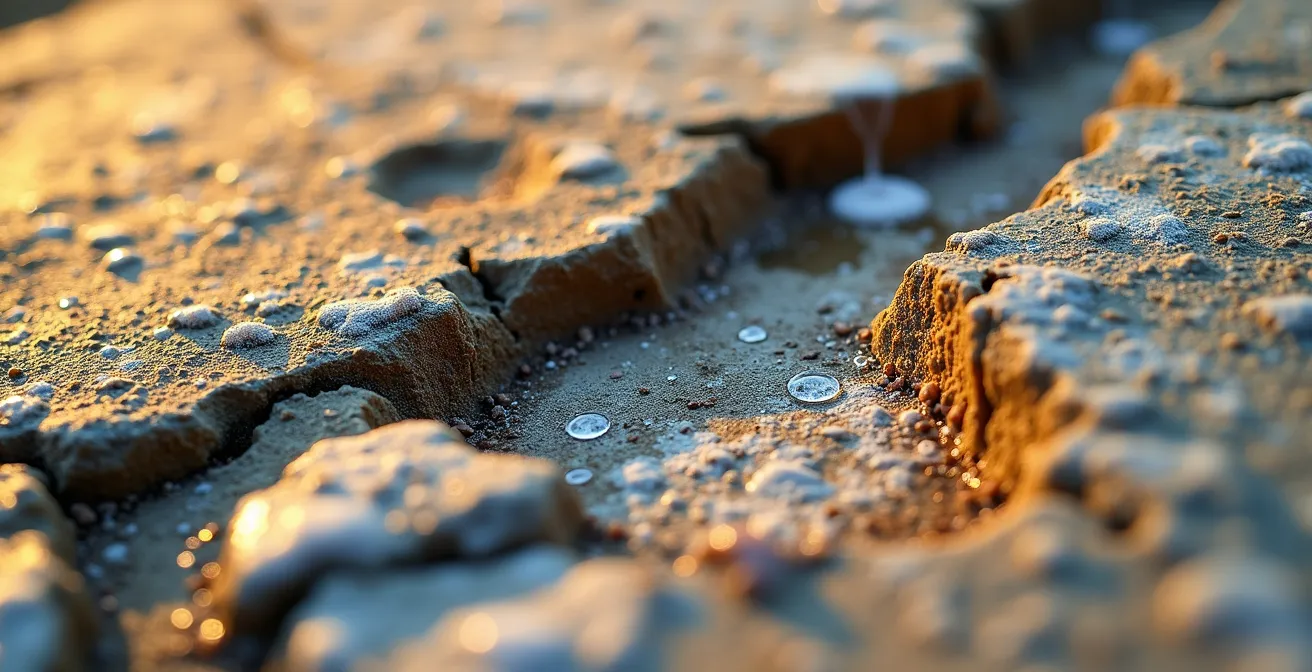
Heritage foundations, typically made of fieldstone, rubble, or early-generation concrete, are uniquely susceptible to issues modern structures don’t face. The primary culprit in the Canadian climate is the relentless freeze-thaw cycle. Water penetrates porous old mortar and stone, freezes, expands, and systematically disintegrates the foundation from within. This isn’t a simple crack; it’s a progressive structural failure that requires specialized, expensive remediation. Ignoring early signs like minor dampness in the basement or small step cracks is a recipe for disaster.
A proper assessment goes beyond a simple visual inspection. It requires a specialist engineer who understands historic masonry. They will investigate water management around the property, assess the state of the mortar, and may use core samples to understand the substrate. The mistake is assuming a foundation that “looks solid” is structurally sound. Underpinning, waterproofing, and repointing a historic foundation with appropriate lime-based mortar is a highly specialized trade. Budgeting for it as a contingency is wise; being forced into it as an emergency repair is financially devastating.
How to Insulate a Brick Heritage Building Without Damaging the Masonry?
Upgrading the thermal performance of a historic brick building is a top priority for creating a modern, leasable space. However, the wrong approach can inflict irreversible damage on the very structure you’re trying to improve. Historic masonry walls are designed to “breathe”—they manage moisture by allowing water vapour to pass through them. Sealing them with improper modern insulation, like closed-cell spray foam, traps moisture within the brick, leading to spalling, efflorescence, and eventual structural failure during freeze-thaw cycles. This is a classic case of a well-intentioned upgrade causing catastrophic harm.
The solution lies in understanding the concept of building envelope performance as a system, not just an R-value target. The goal is to improve insulation while maintaining or enhancing the wall’s ability to dry out. As technical guidance from authorities like Parks Canada stresses, preserving vapour permeability is paramount. This means selecting insulation materials that allow moisture to escape.
The choice of insulation method represents a trade-off between budget, performance, and risk. A “Good, Better, Best” framework helps clarify these options. While a simple interior air gap is the most breathable, its thermal improvement is minimal. At the other end of the spectrum, a new interior stud wall with a ventilated cavity provides maximum insulation and moisture control but comes at the highest cost. A balanced “Better” approach often provides the best ROI for commercial projects.
| Level | Method | R-Value Improvement | Masonry Protection | Budget Range |
|---|---|---|---|---|
| Good | Interior air gap with minimal insulation | R-8 to R-12 | Excellent – maintains breathability | $ |
| Better | Wood fibreboard or cork boards | R-12 to R-20 | Good – allows moisture management while improving some insulation values | $$ |
| Best | New interior wall with ventilated cavity | R-20+ | Excellent – complete moisture control | $$$ |
Why Your Building Renovation Might Qualify for a Tax Increment Grant?
A Tax Increment Grant (TIG) is one of the most powerful and often misunderstood financial instruments in the developer’s toolkit. It is not a handout; it is a strategic partnership with a municipality. The premise is simple: your renovation project will increase the assessed value of the property, which in turn increases the property tax revenue for the city. A TIG program rebates a portion of that *increase* (the “increment”) back to you over a set period, typically 5-10 years, effectively helping you finance the very development that generated the new value.
Municipalities offer TIGs because they want to stimulate private sector investment in specific areas, especially downtown cores or heritage districts. With investment in multi-dwelling construction rising and cities competing for growth, a well-pitched heritage project is an attractive proposition. Your project isn’t just about one building; it’s a catalyst for job creation, increased foot traffic, and a signal to other investors that the area is on the rise. This is the narrative you must sell to the municipality.
To successfully secure a TIG, your pitch must be framed in terms of mutual economic benefit. Quantify the projected job creation, both during construction and in the final commercial use. Align your project directly with the city’s official plan or downtown revitalization strategy. Show how TIG support accelerates your timeline, bringing those economic benefits to the community faster. By positioning your project as a key driver of the city’s own economic goals, you transform your application from a request for funds into a proposal for a joint venture in urban renewal.
When to Upgrade Equipment to Maximize New Green Building Grants?
Timing is everything when it comes to leveraging green building grants in a heritage context. These programs, such as the federal Green and Inclusive Community Buildings Program, are not afterthoughts; they require integration from the earliest stages of project planning. Waiting until after the design is finalized to look for green grants is a common mistake that leaves significant money on the table. The most lucrative grants are often tied to achieving specific energy performance targets, which can only be met if they are designed-in from day one.
The critical first step is to conduct comprehensive energy modeling *before* the architectural design is locked in. This analysis will identify the most impactful upgrades for your specific building, whether it’s high-efficiency HVAC, state-of-the-art insulation (as discussed previously), or energy-efficient appliances. For instance, modern Variable Refrigerant Flow (VRF) systems are ideal for heritage buildings as they offer high efficiency with minimal ductwork, preserving historic interiors. This modeling becomes the backbone of your grant application, providing the hard data needed to prove your project’s environmental benefits.
Furthermore, the source of funding often dictates the timing. The federal Legacy Fund, for example, supports projects marking significant anniversaries and requires energy modeling as part of due diligence. Upgrades should be documented meticulously from the start to streamline future applications for standards like LEED or the Zero Carbon Building Standard. Even the choice of solar technology is strategic; while often allowed, panels must typically be hidden from street view. Using options like Tesla’s solar shingles on sloped roofs can be a clever way to meet both heritage and green energy requirements, maximizing both your grant eligibility and the final asset’s value.
Key takeaways
- Heritage designation is a financial tool, not a barrier, unlocking grants and incentives unavailable to new builds.
- Proactive collaboration with heritage officers and a robust Heritage Impact Assessment are key to getting modern upgrades approved.
- The biggest financial risks often lie hidden in the foundation; a specialized engineering assessment is non-negotiable.
Leveraging Local Economic Incentives: How to Access Municipal CIP Grants?
While federal and provincial programs provide a strong foundation, the most immediate and versatile funding for a heritage project often comes from the municipality itself through its Community Improvement Plan (CIP). These plans are the city’s primary tool for directing private investment, and a savvy developer knows how to align their project to become the perfect candidate. Success lies in understanding that you aren’t just restoring a building; you are helping the city achieve its strategic objectives for urban revitalization.
The power of CIPs comes from the ability to “stack” multiple incentives on a single project. A single renovation could potentially qualify for a Heritage Restoration Grant, a Façade Improvement grant, a rebate on building permit fees, and even a waiver of development charges. Each of these programs has its own application, but when pursued in concert, they can dramatically reduce the capital required and improve the project’s overall profitability. Preparing a pre-application meeting with the city’s economic development and heritage departments is a critical step to map out a stacking strategy.
Your approach in these meetings should be one of partnership. Come prepared with a one-page summary that frames your project as a solution to the city’s goals. Bring preliminary drawings that showcase both the heritage preservation elements and the economic activity the new use will generate. Engaging the local architectural conservation advisory committee early can also provide crucial third-party validation. By presenting a well-researched, professionally packaged proposal that clearly demonstrates the multiplier effect of the city’s investment, you position your project as an opportunity the municipality cannot afford to miss.
| Incentive Type | Typical Value | Stackable? | Frequency |
|---|---|---|---|
| Heritage Restoration Grant | $10,000-$35,000 matching | Yes | Every 2 years |
| Façade Improvement | Up to $50,000 | Yes | One-time |
| Development Charge Waiver | Variable | Yes | Per project |
| Building Permit Fee Rebate | 50-100% rebate | Yes | Per permit |
By treating heritage regulations and financial incentives as an interconnected strategic framework, you can systematically de-risk your project and unlock its true value. The next logical step is to identify a target property and begin the pre-application dialogue with municipal authorities to explore the specific CIP incentives available in that jurisdiction.