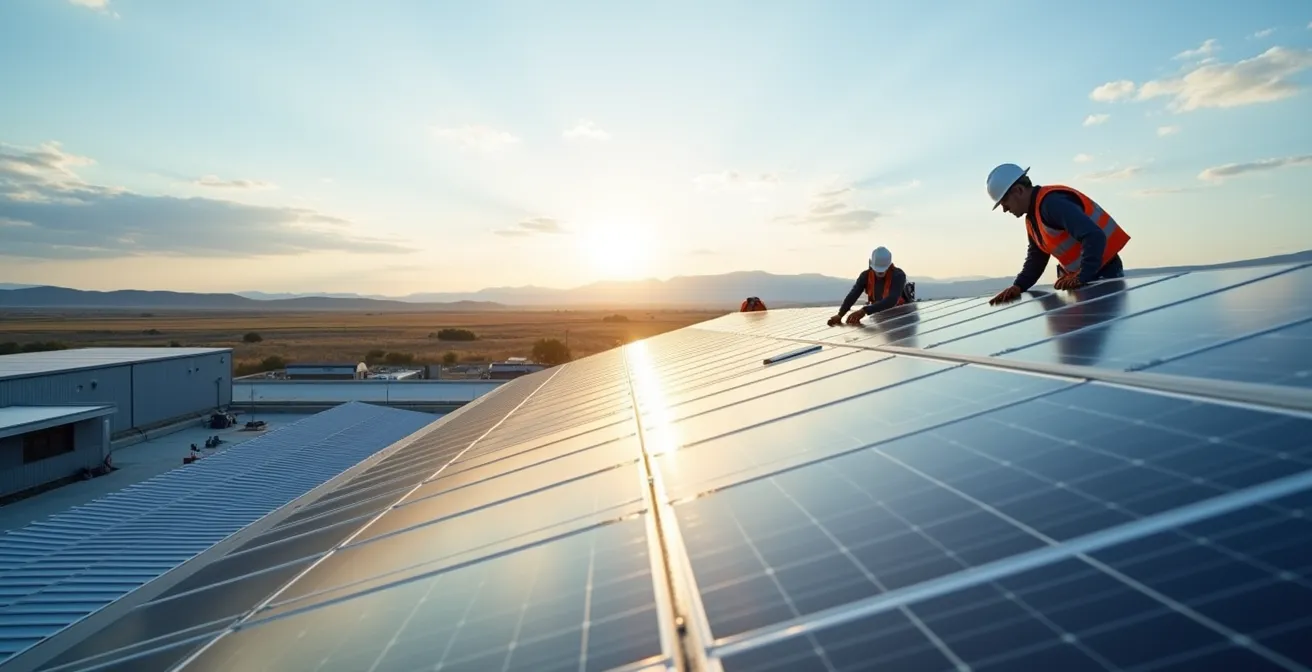
Transitioning your Canadian facility to solar is less a ‘green’ project and more a decisive financial strategy to mitigate risk and lock in long-term energy cost certainty.
- The true ROI hinges on mastering provincial net-metering rules and federal tax incentives like the 30% Clean Technology Investment Tax Credit.
- Avoiding critical engineering oversights, particularly concerning roof load and winter maintenance, is paramount to ensuring operational reliability and insurance compliance.
Recommendation: Your next step is to move beyond generic cost-saving estimates and commission a formal engineering and financial feasibility study to quantify these variables for your specific facility and province.
For a manufacturing plant manager in Canada, the pressure to reduce both energy costs and carbon footprint is relentless. Monthly energy bills fluctuate with market volatility, and the escalating federal carbon tax adds a layer of predictable, yet painful, expense to the bottom line. The conventional wisdom suggests that installing solar panels is the obvious solution—a way to generate clean energy and achieve long-term savings. You’ve likely heard the generic advice: “it’s good for the environment” and “it lowers your electricity bill.”
While true, this surface-level view misses the core strategic opportunity. Viewing a solar transition merely as an operational cost-reduction measure is a fundamental error. The most competitive Canadian operators are treating it as a sophisticated financial maneuver. The real question isn’t *if* you should adopt solar, but *how* you can architect the transition to de-risk your operations, create a predictable cost structure, and turn regulatory pressures like the carbon tax into a quantifiable financial advantage. This is about moving from a reactive, cost-saving mindset to a proactive, value-creation strategy.
This guide bypasses the environmental platitudes to provide a technical and economic framework specifically for Canadian facility managers. We will dissect the financial levers, from provincial arbitrage to tax-advantaged capital allocation, explore the critical technology choices for our demanding climate, and identify the engineering risks that can derail a project. It’s time to build a business case that stands up to CFO scrutiny.
This article provides a comprehensive roadmap for your facility’s solar transition, broken down into key strategic considerations. The following summary outlines the critical financial, technical, and regulatory milestones we will cover to ensure your project delivers maximum value and operational resilience.
Summary: Adopting Renewable Energy: A Facility Manager’s Technical Guide
- Why You Can “Sell” Excess Power Back to the Grid in Some Provinces but Not Others?
- How to Calculate the True ROI of Commercial Solar Panels in Canada?
- Lithium-Ion vs. Flow Batteries: Which Storage Fits Your Peak Shaving Needs?
- The Roof Load Mistake That Voids Your Building Insurance
- When to Schedule Solar Installation to Maximize Summer Generation?
- Natural Gas vs. Electrification: Which is Cheaper Over a 10-Year Horizon?
- The Maintenance Oversight That Leaves Trucks Stranded at -30°C
- Adapting to Regulatory Changes: How Will the Carbon Tax Impact Your Bottom Line?
Why You Can “Sell” Excess Power Back to the Grid in Some Provinces but Not Others?
The ability to “sell” excess solar generation is not a uniform Canadian privilege; it is dictated by provincial net-metering or net-billing policies, which vary dramatically. These programs determine how you are compensated for the electricity your facility sends back to the grid. In provinces like Alberta and Ontario, net-metering programs typically credit you at the full retail rate for every kilowatt-hour (kWh) you export. This means the power you send out is valued the same as the power you draw in, maximizing the economic benefit of your system. These credits are often valid for up to 12 months, allowing you to bank summer overproduction to offset winter consumption.
In contrast, other provinces utilize different models. British Columbia offers net-metering at the retail rate but pays out any annual surplus at a lower, specified rate. Saskatchewan employs a hybrid Power Generation Partner Program (PGPP) where excess electricity is converted to credits at a fixed rate, currently 7.5 ct/kWh, which can be carried forward indefinitely. Manitoba uses a net-billing model, where the credit for exported energy is set at a rate lower than the retail price. This regulatory patchwork means that a solar project’s financial viability in one province cannot be directly compared to another. Understanding your specific provincial framework is the first step in any accurate ROI calculation.
This comparative table from EnergyHub.org highlights the fundamental differences between key provincial programs, illustrating why a one-size-fits-all approach to solar economics is bound to fail in Canada. As seen in the analysis, Alberta’s deregulated market offers a different risk-reward profile compared to the structured programs in Ontario or BC.
| Province | Program Type | Credit Rate | Key Features |
|---|---|---|---|
| Alberta | Net Metering | Retail rate | Systems up to 5 MW, competitive deregulated market |
| Ontario | Net Metering | Retail rate | Credits valid for 12 months, systems up to 500 kW |
| British Columbia | Net Metering | Retail rate | Annual net surplus sold at 9.99¢/kWh, up to 100 kW |
| Saskatchewan | Net Metering/PGPP | 7.5¢/kWh | Credits carry forward indefinitely, hybrid model available |
| Manitoba | Net Billing | 6.546¢/kWh | Lower than retail rate, monetary credits applied |
This provincial arbitrage is a critical lever in your business case; what works as a high-return investment in Alberta might only be marginally profitable in Manitoba without additional strategies.
How to Calculate the True ROI of Commercial Solar Panels in Canada?
Calculating the true Return on Investment (ROI) for a commercial solar project in Canada goes far beyond a simple payback calculation based on avoided electricity costs. A CFO-ready analysis must incorporate a multi-layered financial model that accounts for federal and provincial tax mechanisms, demand charge reductions, and future carbon cost avoidance. The cornerstone of this calculation is the federal Clean Technology Investment Tax Credit (ITC). This federal program provides a refundable tax credit of up to 30% of the project’s total capital cost, dramatically reducing the initial cash outlay and accelerating the payback period.
Beyond the ITC, another powerful lever is the Accelerated Capital Cost Allowance (CCA). Under Class 43.2, clean energy generation equipment can be fully written off in the first year, providing a significant tax shield that improves the project’s Net Present Value (NPV). Furthermore, in markets like Ontario and Alberta, a substantial portion of a commercial electricity bill comes from demand charges, which are based on the highest peak power usage during a billing period. A solar-plus-storage system can be engineered for peak shaving, directly targeting these charges for massive savings that simple solar-only systems cannot achieve.
Finally, the escalating federal carbon tax must be modeled as a direct, quantifiable benefit. Every kWh of electricity generated on-site from solar is a kWh you don’t have to purchase from a grid that may be powered by natural gas, thus avoiding the associated carbon tax liability. This “avoided cost” becomes a growing revenue stream for the project as the carbon tax increases annually. A proper ROI calculation synthesizes all these variables to present a comprehensive financial picture.
Your Action Plan: CFO-Ready Metrics for Solar ROI Calculation
- Net Present Value (NPV): Begin your calculation by incorporating the 30% federal Clean Technology Investment Tax Credit to determine the true initial capital cost.
- Tax Shield Modeling: Apply the Accelerated Capital Cost Allowance (CCA), allowing for a 100% write-off in the first year under Class 43.2, to model the immediate tax benefits.
- Demand Charge Analysis: Factor in specific demand charge reduction opportunities, particularly relevant and lucrative in the Ontario and Alberta markets.
- Carbon Cost Avoidance: Model the avoided costs from the federal carbon tax based on the official escalation schedule through 2030, turning a liability into a project asset.
- Provincial Credit Integration: Include the value of net metering or net billing credits at the rates applicable to your specific jurisdiction.
Failing to account for any of these layers results in an incomplete and likely underestimated projection of the project’s long-term financial performance.
Lithium-Ion vs. Flow Batteries: Which Storage Fits Your Peak Shaving Needs?
For a manufacturing facility, where energy-intensive processes create significant demand spikes, a solar installation’s value is magnified when paired with a Battery Energy Storage System (BESS). The primary function of a BESS in this context is peak shaving: storing solar energy when generation is high and demand is low, then discharging it during peak demand hours to avoid pulling expensive power from the grid and incurring high demand charges. The choice of battery technology is a critical decision driven by your facility’s specific operational profile.
The dominant technology, Lithium-Ion, is known for its high energy density and efficiency, making it a compact solution. It responds rapidly, making it ideal for applications requiring quick bursts of power. However, lithium-ion batteries degrade with each charge-discharge cycle, and their performance can be affected by extreme temperatures, a significant consideration in the Canadian climate. Their lifespan is typically 10-15 years, and there are end-of-life recycling challenges.
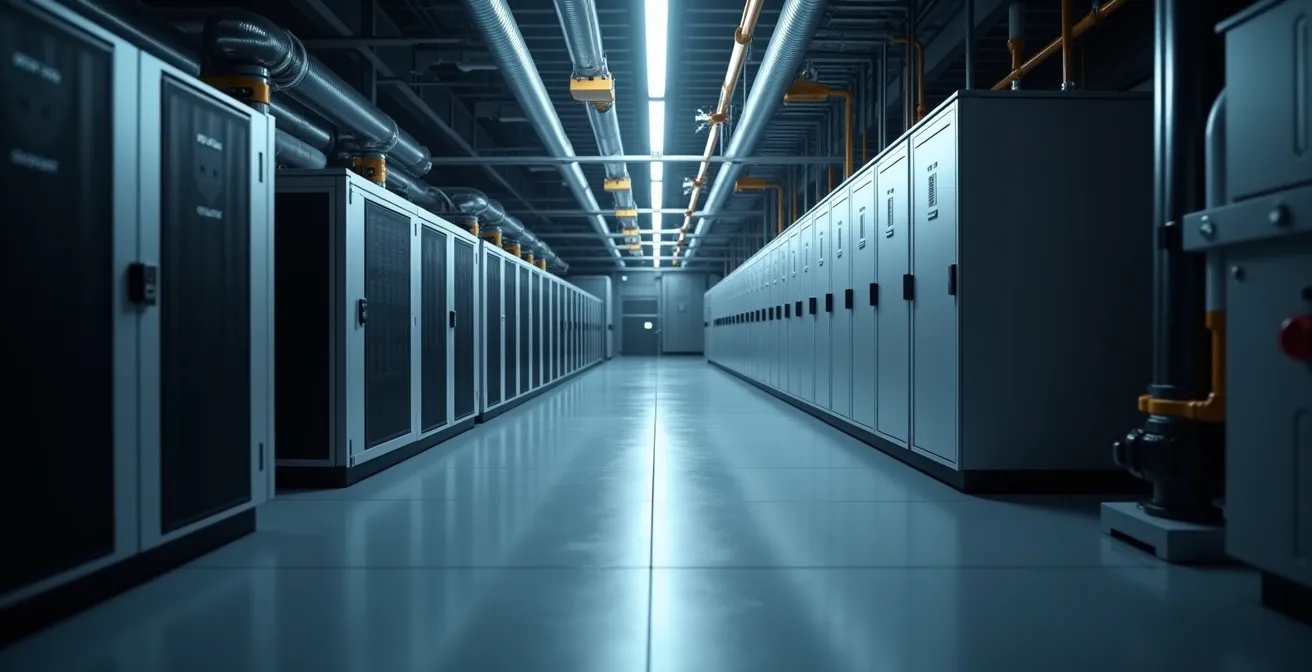
As the image illustrates, the physical footprint and complexity of battery systems differ significantly. An emerging alternative, particularly for large-scale industrial use, is the Vanadium Flow Battery (VFB). VFBs offer a much longer lifespan (20+ years) with no degradation in capacity over time. They can be discharged 100% without damage and are non-flammable, offering a superior safety profile. Their main drawback has traditionally been lower energy density, requiring more physical space. However, as Matt Harper, Chief Commercial Officer of Invinity Energy Systems, notes, this is changing: “If we’re talking specifically about energy density, it depends on the layout of a specific site, but broadly speaking, we’re going to be equal to or better than what lithium is able to do.” The large-scale 8.4 MWh Vanadium Flow Battery project in Alberta, co-located with a 21 MWp solar array, demonstrates the growing viability of this technology for industrial applications in Canada.
Your choice will impact not just upfront capital costs but also long-term operational expenses, safety protocols, and the overall lifespan of your energy storage asset.
The Roof Load Mistake That Voids Your Building Insurance
One of the most catastrophic and easily avoidable mistakes in a commercial solar transition is failing to properly account for the structural integrity of your facility’s roof. The added weight of solar panels, racking, and—critically in Canada—potential snow load is a significant engineering challenge that has direct implications for your building’s insurance policy. Simply getting an assessment from a solar installer is grossly insufficient and will be rejected by any diligent insurance underwriter. Before a single panel is installed, a new structural assessment must be completed and stamped by a Professional Engineer (P.Eng.) licensed in the specific province of installation. This is a non-negotiable legal and insurance requirement.
The engineer’s analysis must account for the building’s existing load capacity and the additional static load of the solar array. More importantly, it must model the dynamic loads unique to your location based on the National Building Code of Canada. For a flat-roofed warehouse in Calgary’s “Hailstone Alley,” this means accounting for immense snow loads and the potential impact of major hail. For a facility in Richmond, B.C., the primary concerns might be seismic uplift and high wind-load requirements. Failure to obtain a P.Eng. stamp that certifies the roof can handle these combined loads effectively voids your property insurance coverage for any incident related to a roof failure.

This is not a corner to cut. The cost of a proper engineering assessment is a minute fraction of the potential financial fallout from a roof collapse, which would include not only the direct cost of repairs and the solar asset itself but also business interruption and likely legal liability. To maintain coverage, your commercial property policy will require a specific ‘rider’ or ‘endorsement’ to cover the solar asset against Canadian-specific perils like ice damming and hail, and this will only be issued upon presentation of the stamped structural assessment.
This is the foundational step of physical due diligence, protecting both your asset and your insurance eligibility from the outset.
When to Schedule Solar Installation to Maximize Summer Generation?
In Canada, the timing of a solar project is governed by a simple truth: the vast majority of annual electricity generation occurs during the long, sunny days between May and September. To maximize your first-year ROI, your system must be fully commissioned and operational by May 1st at the latest. Missing this window means forfeiting a significant portion of your peak earning potential. This requires a disciplined project management approach and a deep understanding of the “reverse timeline” for solar installation in the Canadian context.
Achieving a May 1st operational date means physical installation must occur in late winter or early spring (March-April). This timing is strategic, avoiding the ground-freezing challenges of deep winter and the logistical nightmare of spring thaw, especially in regions with muskeg conditions. This, in turn, means that all engineering must be finalized and equipment procured and delivered by February. The longest lead time in this entire process is often permitting. In major municipalities like Toronto or Vancouver, securing all necessary permits can take anywhere from three to six months. Therefore, permit submissions must be completed no later than the preceding October or November.
This backward planning reveals that a project kickoff, including the initial site assessment and preliminary engineering, must happen in September—a full eight months before the target operational date. Complicating this timeline is the intense competition for qualified labor. As highlighted by the “gold rush” of solar development in Southern Alberta, the demand for experienced installers during the peak March-April construction window is immense. Securing a reputable installation crew for a spring build often requires booking and committing to a contract in the late fall or early winter of the previous year. Waiting until the new year to start planning all but guarantees you will miss the summer generation window.
- September: Project kickoff, site assessment, initial engineering.
- October-November: Permitting submissions (expect 3-6 months processing in major cities).
- December-January: Engineering finalization and equipment procurement.
- February: Equipment delivery and on-site staging.
- March-April: Physical installation (avoiding deep winter and spring thaw).
- April 15-30: Final commissioning and utility interconnection approval.
- May 1: System operational for peak summer generation.
Proactive scheduling is the key to transforming a plan on paper into a performing asset by the time the summer sun arrives.
Natural Gas vs. Electrification: Which is Cheaper Over a 10-Year Horizon?
The decision to electrify operations and move away from natural gas is a long-term capital allocation choice that must be evaluated through the lens of Total Cost of Ownership (TCO) over at least a 10-year horizon. While natural gas may appear cheaper on a per-unit basis today in some regions like Alberta, this view ignores two critical financial factors: the escalating federal carbon tax and the concept of stranded asset risk. A full electrification strategy, powered by on-site solar, provides cost certainty in a way that continued reliance on fossil fuels cannot.
The 10-year TCO varies significantly by province, driven primarily by the carbon intensity of the local grid. In Quebec and British Columbia, which benefit from vast, low-cost hydroelectric grids, the business case for electrification is overwhelmingly positive. Even with the upfront capital cost of a solar and electric heating system, the long-term TCO per MWh is significantly lower than relying on natural gas burdened by a rising carbon tax. In Ontario, the mix of nuclear and hydro also gives electrification a decisive edge. The outlier is Alberta, where a high-carbon grid can, in some scenarios, make solar electrification slightly more expensive over 10 years, though this calculation often omits the full benefits of demand charge reduction and other incentives.
The most significant financial risk, however, is that of a stranded asset. The Government of Canada has a stated goal to achieve a 100% net-zero electricity grid by 2035 and a net-zero economy by 2050. Investing in new natural gas-fired equipment today means installing an asset that will almost certainly face regulatory obsolescence and punitive carbon pricing well within its operational lifespan. This future liability must be factored into any responsible long-term financial plan.
This comparative analysis, based on data from Natural Resources Canada, models the projected Total Cost of Ownership and demonstrates the clear advantage of electrification in provinces with clean grids. It underscores the financial risk of continued investment in natural gas infrastructure.
| Province | Natural Gas TCO/MWh (2024-2034) | Solar + Electric TCO/MWh | Key Factor |
|---|---|---|---|
| Quebec | $95 (with carbon tax) | $45 | Low-cost clean hydro grid |
| Alberta | $65 (low gas cost) | $75 | High-carbon grid offsets solar benefits |
| Ontario | $85 (with carbon tax) | $60 | Nuclear/hydro mix favors electrification |
| British Columbia | $90 (with carbon tax) | $50 | Clean hydro grid advantage |
The decision is not merely about next year’s operating budget; it’s about positioning your facility for economic viability in a decarbonizing world.
The Maintenance Oversight That Leaves Trucks Stranded at -30°C
For Canadian facilities, particularly those operating vehicle fleets, the integration of solar power cannot be considered in isolation. The transition to solar often runs parallel to fleet electrification, and the interplay between these two systems in extreme cold is a critical operational risk. A common and dangerous oversight is failing to account for the compounding efficiency losses of both solar panels and Electric Vehicle (EV) batteries at temperatures of -20°C to -30°C and below. At these temperatures, solar panel output can drop, while an EV’s battery range can decrease by as much as 40%. This creates a perfect storm where generation is reduced just as charging demand increases to compensate for lower fleet efficiency.
A facility that plans its solar and EV charging capacity based on ideal summer conditions will find its operations crippled during a cold snap. Trucks can be left stranded with insufficient charge, unable to complete their routes. This is especially true for facilities aiming for grid independence during outages. A maintenance and operational plan must explicitly budget for a winter generation loss of 20-40% from the solar array due to lower sun angles, shorter days, and potential snow cover. Simultaneously, it must assume a corresponding increase in the energy required to charge the EV fleet to achieve its necessary operational range.

The physical maintenance of the system is equally crucial. Snow and ice accumulation, as shown in the close-up, can render panels useless until they are cleared. While steep-angled panels can shed snow naturally, large flat-roof arrays require a dedicated snow removal plan. This is not a trivial task; it involves safety protocols and specialized equipment to avoid damaging the panels. Furthermore, all charging hardware, from the chargers themselves to the cabling, must be rated for extreme cold weather operation. Using equipment not designed for Canadian winters is a recipe for failure, leaving your fleet powerless when it’s needed most.
This foresight separates a resilient, all-weather operation from one that is vulnerable to the predictable rigors of a Canadian winter.
Key Takeaways
- A successful solar transition is a financial project, leveraging tax credits (30% ITC, Accelerated CCA) and provincial net-metering for maximum ROI.
- Mitigating risk is paramount; this requires a P.Eng.-stamped structural assessment to ensure insurance compliance and a robust maintenance plan for extreme Canadian weather.
- Viewing the escalating carbon tax as an “avoided cost” transforms it from a liability into a key justification for the project’s long-term value.
Adapting to Regulatory Changes: How Will the Carbon Tax Impact Your Bottom Line?
For any Canadian business with a significant energy footprint, the federal carbon tax is no longer a minor expense; it is a material and escalating operational cost that must be managed strategically. The most effective way to mitigate this liability is to reframe it entirely. Instead of viewing it as a tax, savvy operators are approaching it as an opportunity for carbon tax arbitrage. By investing in on-site, zero-emission electricity generation like solar, you are effectively “shorting” the carbon market. Every dollar the carbon tax goes up is a dollar you are saving, directly boosting the ROI of your solar investment.
The financial impact of this strategy is significant and growing. Under the federal government’s schedule, the price on carbon pollution is set to increase steadily, reaching $170 per tonne of CO2 by 2030. For a facility reliant on grid electricity generated from natural gas, this translates into a large and predictable increase in energy costs. A solar installation insulates your bottom line from this volatility. The avoided cost associated with the carbon tax becomes a core, quantifiable revenue stream in your project’s financial model, making the business case more compelling with each passing year.
This perspective fundamentally changes the investment calculus. The solar project is no longer just an energy-saving initiative; it’s a hedge against future regulatory costs. As the 2024 Clean Energy Investment Report from Clean Energy Canada aptly puts it, this strategy allows the tax to become a powerful justification for the project itself.
Frame solar investment as ‘Carbon Tax Arbitrage’ – the tax turns from a pure liability into a quantifiable justification for the solar project’s ROI
– Clean Energy Canada, 2024 Clean Energy Investment Report
The next logical step is to commission a detailed feasibility study that models this avoided cost alongside other incentives, providing a complete picture of the long-term financial benefits for your facility.